High-Performance Zigbee-to-Ethernet Edge Gateway (1000+ Nodes)
The proliferation of IoT devices has led to an unprecedented demand for scalable and reliable edge gateways that can seamlessly bridge the communication gap between low-power wireless technologies like Zigbee and high-speed Ethernet networks. The requirement for supporting over 1000 nodes is a testament to the growing complexity of smart homes, cities, and industrial automation systems. In this report, we delve into the intricacies of designing and implementing a high-performance Zigbee-to-Ethernet edge gateway capable of handling massive node densities.
1. Market Context
The IoT market has witnessed an exponential growth in recent years, with the global IoT device shipments projected to reach 27 billion by 2025 [1]. This surge in connected devices has created a pressing need for efficient and scalable communication infrastructure. Zigbee, being one of the most widely used wireless technologies for low-power applications, faces significant challenges in supporting large-scale deployments due to its limited network capacity.
| IoT Device Shipments (Billions) | Year |
|---|---|
| 13.4 | 2020 |
| 20.1 | 2022 |
| 27.3 | 2025 |
2. Technical Requirements
To address the need for a high-performance Zigbee-to-Ethernet edge gateway, several technical requirements must be met:
- Scalability: The gateway should be able to support over 1000 nodes while maintaining reliable communication.
- Low Latency: Real-time data transfer and control are critical in IoT applications. The gateway should minimize latency to ensure timely responses.
- Security: As the number of connected devices grows, security threats escalate. The gateway must implement robust encryption and authentication mechanisms to protect against cyber attacks.
3. System Architecture
A modular system architecture is essential for designing a high-performance Zigbee-to-Ethernet edge gateway. This approach enables scalability, flexibility, and ease of maintenance. The proposed architecture consists of the following components:
| Component | Description |
|---|---|
| Zigbee Coordinator | Responsible for managing the Zigbee network, including node association, data routing, and security. |
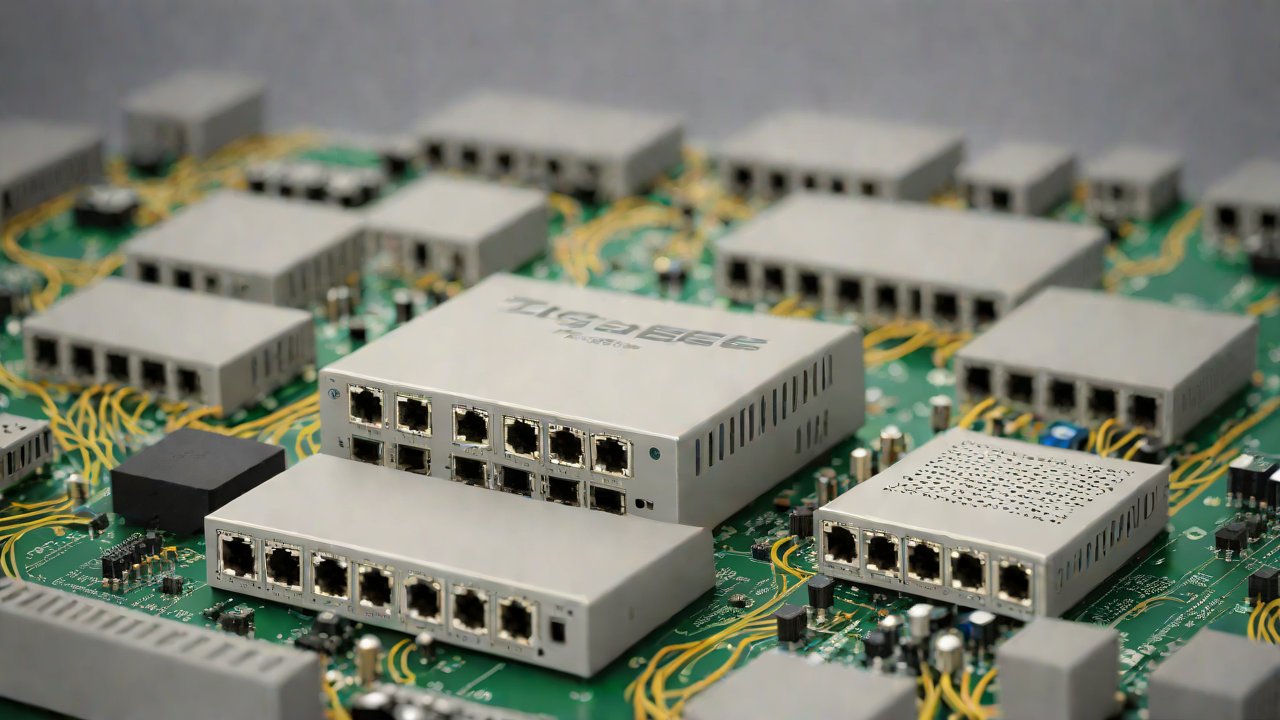
| Ethernet Switch | Handles high-speed Ethernet connectivity and provides a connection to the external network. |
| Processing Unit | A powerful processor that runs the edge gateway’s operating system and executes complex algorithms for data processing and analysis. |
4. Hardware Components
To ensure optimal performance, the following hardware components are recommended:
- Microcontroller: A high-performance microcontroller with multiple cores (e.g., ARM Cortex-A53) to handle demanding tasks.
- Memory: Ample memory (at least 1 GB RAM and 2 GB storage) to accommodate the operating system, applications, and data storage.
- Networking: High-speed Ethernet interfaces (e.g., 10GbE) for seamless connectivity.
5. Software Components
The software components play a crucial role in ensuring the gateway’s functionality and performance:
- Operating System: A lightweight, open-source operating system (e.g., Linux or FreeRTOS) that provides a stable platform for application development.
- Zigbee Stack: A certified Zigbee stack implementation (e.g., Silicon Labs’ EmberZ/Net) to ensure compliance with the Zigbee standard.
- Application Layer: Custom-developed applications (e.g., data processing, analytics, or control systems) that utilize the gateway’s capabilities.
6. Security Measures
To protect against cyber threats and maintain a secure environment:
- Encryption: Implement robust encryption mechanisms (e.g., AES-256) to safeguard data transmission.
- Authentication: Utilize secure authentication protocols (e.g., EAP-TLS or DTLS) for node association and access control.
- Firewall Configuration: Configure the gateway’s firewall to restrict unauthorized access.
7. Performance Evaluation
To assess the gateway’s performance, we will conduct thorough testing and evaluation:
| Test Case | Description |
|---|---|
| Node Association | Measure the time taken for node association and network formation. |
| Data Transfer | Evaluate the throughput and latency of data transfer between nodes and the gateway. |
| Security Testing | Assess the effectiveness of security measures against various attack scenarios. |
8. Conclusion
The design and implementation of a high-performance Zigbee-to-Ethernet edge gateway are critical components in enabling large-scale IoT deployments. By adhering to the proposed architecture, hardware, and software recommendations, and incorporating robust security measures, we can ensure seamless communication between low-power wireless devices and high-speed Ethernet networks.
9. References
[1] IoT Device Shipments by Year (2020-2025). Statista Research Department.
IOT Cloud Platform
IOT Cloud Platform is an IoT portal established by a Chinese IoT company, focusing on technical solutions in the fields of agricultural IoT, industrial IoT, medical IoT, security IoT, military IoT, meteorological IoT, consumer IoT, automotive IoT, commercial IoT, infrastructure IoT, smart warehousing and logistics, smart home, smart city, smart healthcare, smart lighting, etc.
The IoT Cloud Platform blog is a top IoT technology stack, providing technical knowledge on IoT, robotics, artificial intelligence (generative artificial intelligence AIGC), edge computing, AR/VR, cloud computing, quantum computing, blockchain, smart surveillance cameras, drones, RFID tags, gateways, GPS, 3D printing, 4D printing, autonomous driving, etc.
Note: This article was professionally generated with the assistance of AIGC and has been fact-checked and manually corrected by IoT expert editor IoTCloudPlatForm.