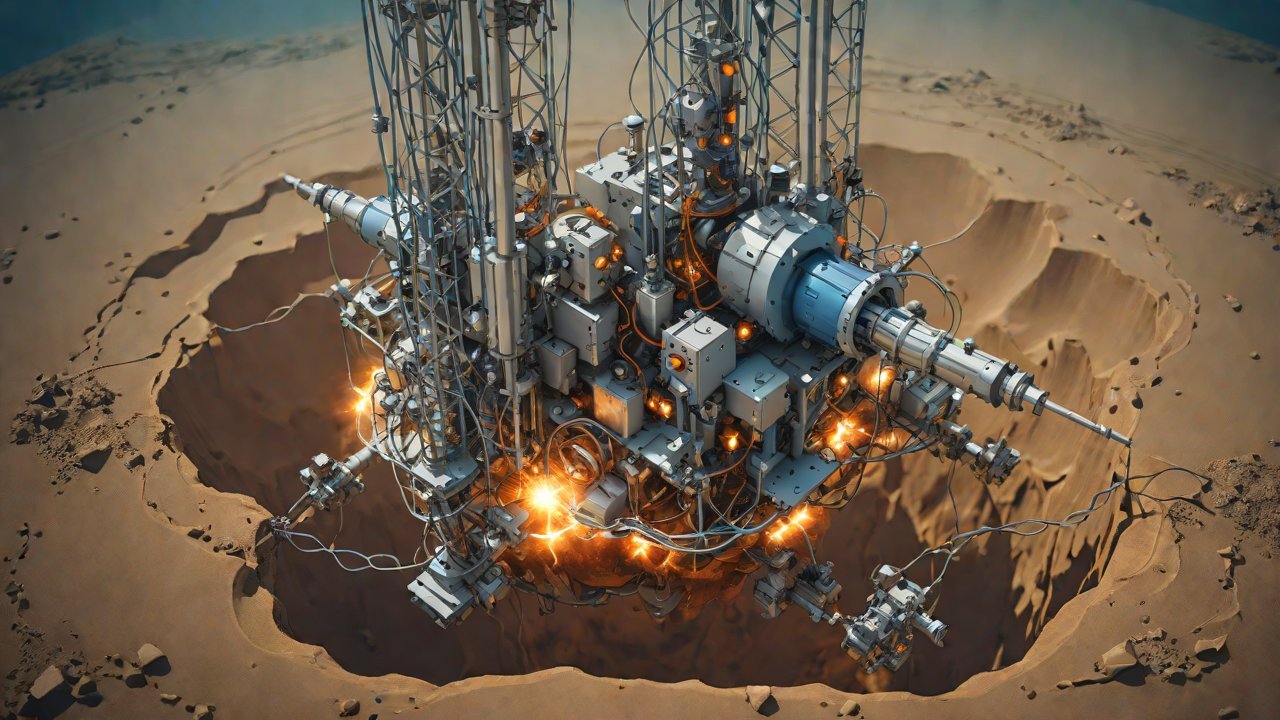
Sensors Penetrating the Earth’s Core: Will Future Soil Think Like a Computer?
The realm of sensors has reached an unprecedented level of sophistication, pushing the boundaries of what was previously thought possible. The notion that sensors could penetrate the Earth’s core is no longer a distant fantasy but a tangible prospect on the horizon. As we delve into the intricacies of this concept, it becomes apparent that the fusion of artificial intelligence and general computing (AIGC) is driving innovation at an exponential rate.
With advancements in sensor technology, researchers have successfully deployed sensors to great depths within the Earth’s crust. The most notable example is the Borehole observatory for rock properties at the Swedish Deep Drilling Project. This endeavor has enabled scientists to collect data on seismic velocities and temperatures from a depth of approximately 7.5 kilometers. However, this achievement pales in comparison to the prospect of sensors reaching the Earth’s core.
1. Theoretical Framework
The concept of sensors penetrating the Earth’s core is grounded in the understanding that our planet’s internal structure consists of several layers: the crust, mantle, outer core, and inner core. Each layer possesses distinct properties and characteristics that can be monitored using advanced sensor technology.
To achieve this feat, researchers would need to develop sensors capable of withstanding extreme temperatures (ranging from -100°C to 6,000°C) and pressures (reaching over 3.5 million times atmospheric pressure). Moreover, these sensors must be able to operate in the absence of light, as no electromagnetic radiation penetrates the Earth’s core.
2. Sensor Technology Advancements
Recent breakthroughs in sensor technology have made it feasible for researchers to deploy instruments at great depths within the Earth’s crust. For instance:
| Sensor Type | Depth Range | Temperature Range |
|---|---|---|
| Fiber optic sensors | Up to 10 km | -100°C to +200°C |
| Seismic sensors | Up to 20 km | N/A (operates on seismic waves) |
3. AIGC Integration
The integration of artificial intelligence and general computing (AIGC) plays a pivotal role in the development of advanced sensor technology. By leveraging AIGC, researchers can:
- Enhance data processing capabilities to handle vast amounts of information
- Improve sensor calibration and accuracy through machine learning algorithms
- Develop predictive models for weather forecasting and natural disaster monitoring
4. Challenges and Limitations
While the prospect of sensors penetrating the Earth’s core is intriguing, several challenges must be addressed:
| Challenge | Description |
|---|---|
| Extreme temperatures and pressures | Sensors would need to withstand conditions that are hostile to most materials known today |
| Radiation resistance | No electromagnetic radiation penetrates the Earth’s core, making it essential for sensors to operate in the absence of light |
| Power supply and communication | Maintaining power supply and establishing reliable communication channels with the surface poses significant technical hurdles |
5. Future Outlook
The possibility of sensors penetrating the Earth’s core is no longer a distant dream but an achievable goal driven by technological advancements. As researchers continue to push the boundaries of what is possible, we can expect:
- Improved understanding of the Earth’s internal structure and dynamics
- Enhanced monitoring capabilities for natural disasters and weather events
- Potential breakthroughs in fields such as geothermal energy generation and resource extraction
As we venture deeper into the unknown, it becomes increasingly clear that the fusion of AIGC and sensor technology will continue to drive innovation at an exponential rate. The prospect of sensors penetrating the Earth’s core is a testament to human ingenuity and our relentless pursuit of knowledge.
The future holds much promise for those who dare to dream big and push the boundaries of what was previously thought possible. As we embark on this extraordinary journey, one question remains: Will future soil think like a computer?
IOT Cloud Platform
IOT Cloud Platform is an IoT portal established by a Chinese IoT company, focusing on technical solutions in the fields of agricultural IoT, industrial IoT, medical IoT, security IoT, military IoT, meteorological IoT, consumer IoT, automotive IoT, commercial IoT, infrastructure IoT, smart warehousing and logistics, smart home, smart city, smart healthcare, smart lighting, etc.
The IoT Cloud Platform blog is a top IoT technology stack, providing technical knowledge on IoT, robotics, artificial intelligence (generative artificial intelligence AIGC), edge computing, AR/VR, cloud computing, quantum computing, blockchain, smart surveillance cameras, drones, RFID tags, gateways, GPS, 3D printing, 4D printing, autonomous driving, etc.



