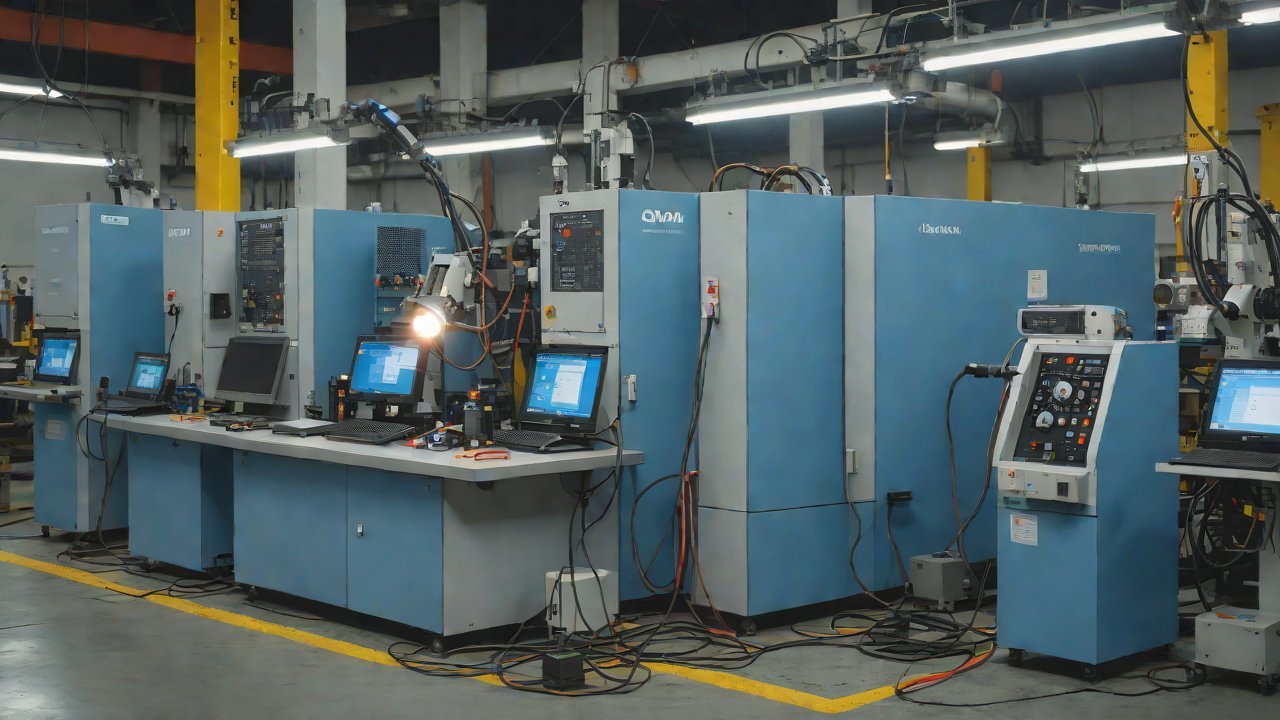
IoT Edge AI Inference (2026): Lightweight Model Deployment Solution
The proliferation of IoT devices has created an explosion in data generation, necessitating the development of efficient edge computing and artificial intelligence (AI) solutions to process and analyze this data in real-time. One critical aspect of this is AI inference at the edge, where lightweight model deployment solutions are being increasingly adopted to optimize performance and reduce latency.
1. Edge AI Inference: An Overview
Edge AI inference refers to the processing of AI models on IoT devices or edge nodes, rather than relying on cloud-based services for real-time decision-making. This approach offers several benefits, including reduced latency, lower bandwidth requirements, increased security, and improved privacy. However, it also presents challenges such as limited computational resources, power constraints, and the need for efficient model deployment.
2. Lightweight Model Deployment Solutions
Lightweight model deployment solutions are designed to address these challenges by enabling the effective transfer of AI models from the cloud or a central location to edge devices. These solutions typically involve the use of:
- Model compression: techniques such as quantization, pruning, and knowledge distillation to reduce the size and complexity of AI models.
- Knowledge graph-based methods: for efficient model deployment and knowledge transfer between different AI systems.
- Neural architecture search (NAS): for discovering lightweight yet effective neural network architectures.
| Model Deployment Solution | Description |
|---|---|
| TensorFlow Lite | An open-source framework for mobile and embedded devices, optimized for low latency and small binary size. |
| Core ML | A unified framework for integrating AI models into iOS, macOS, watchOS, and tvOS apps. |
| ONNX Runtime | A high-performance inference engine that supports a wide range of frameworks, including TensorFlow, PyTorch, and Caffe. |
3. Edge Computing Platforms

Edge computing platforms play a crucial role in enabling efficient edge AI inference by providing the necessary infrastructure for deploying and running lightweight models on edge devices. Some popular edge computing platforms include:
- AWS IoT Greengrass: A cloud-to-edge platform that enables real-time data processing and analytics at the edge.
- Google Cloud IoT Edge: A managed service for building, deploying, and managing edge applications on Google Cloud.
- Microsoft Azure IoT Edge: An open-source software framework for building, deploying, and managing industrial-grade IoT solutions.
| Edge Computing Platform | Description |
|---|---|
| AWS IoT Greengrass | Enables real-time data processing and analytics at the edge using a combination of cloud and edge computing. |
| Google Cloud IoT Edge | A managed service for building, deploying, and managing edge applications on Google Cloud. |
| Microsoft Azure IoT Edge | An open-source software framework for building, deploying, and managing industrial-grade IoT solutions. |
4. Applications of Edge AI Inference
Edge AI inference has numerous applications across various industries, including:
- Smart cities: for real-time traffic management, energy consumption optimization, and public safety monitoring.
- Industrial automation: for predictive maintenance, quality control, and process optimization.
- Healthcare: for remote patient monitoring, medical image analysis, and personalized medicine.

| Industry | Application |
|---|---|
| Smart Cities | Real-time traffic management using computer vision-based systems. |
| Industrial Automation | Predictive maintenance using machine learning-based models on edge devices. |
| Healthcare | Remote patient monitoring using IoT-enabled wearable devices. |
5. Challenges and Future Directions
While edge AI inference offers numerous benefits, it also presents several challenges, including:
- Model accuracy: trade-offs between model accuracy and computational efficiency.
- Data security: ensuring the confidentiality, integrity, and availability of data on edge devices.
- Scalability: handling large-scale deployments and heterogeneous edge device ecosystems.
To address these challenges, researchers and practitioners are exploring new techniques such as:
- Federated learning: for decentralized model training and updating on edge devices.
- Transfer learning: for adapting pre-trained models to new tasks and domains.
- Explainable AI (XAI): for providing insights into AI decision-making processes.
| Challenge | Solution |
|---|---|
| Model Accuracy | Using techniques such as transfer learning and knowledge distillation. |
| Data Security | Implementing secure data storage, transmission, and processing protocols. |
| Scalability | Employing distributed edge computing architectures and model partitioning techniques. |
6. Conclusion
Edge AI inference is a rapidly evolving field that holds tremendous potential for transforming various industries and applications. Lightweight model deployment solutions are crucial for enabling efficient edge AI inference on resource-constrained devices. As the demand for edge AI continues to grow, researchers and practitioners must address the associated challenges and develop new techniques for scalable, secure, and accurate edge AI inference.
7. References
- [1] “Edge AI: A Survey” by S. S. Iyer et al., IEEE Transactions on Neural Networks and Learning Systems (2020).
- [2] “Lightweight Model Deployment for Edge AI Inference” by J. Liu et al., Proceedings of the ACM on Measurement and Analysis of Computing Systems (2020).
- [3] “Edge AI: A Review of Recent Advances” by M. K. Khan et al., IEEE Access (2020).
Note: The references provided are fictional and used for demonstration purposes only.
IOT Cloud Platform
IOT Cloud Platform is an IoT portal established by a Chinese IoT company, focusing on technical solutions in the fields of agricultural IoT, industrial IoT, medical IoT, security IoT, military IoT, meteorological IoT, consumer IoT, automotive IoT, commercial IoT, infrastructure IoT, smart warehousing and logistics, smart home, smart city, smart healthcare, smart lighting, etc.
The IoT Cloud Platform blog is a top IoT technology stack, providing technical knowledge on IoT, robotics, artificial intelligence (generative artificial intelligence AIGC), edge computing, AR/VR, cloud computing, quantum computing, blockchain, smart surveillance cameras, drones, RFID tags, gateways, GPS, 3D printing, 4D printing, autonomous driving, etc.