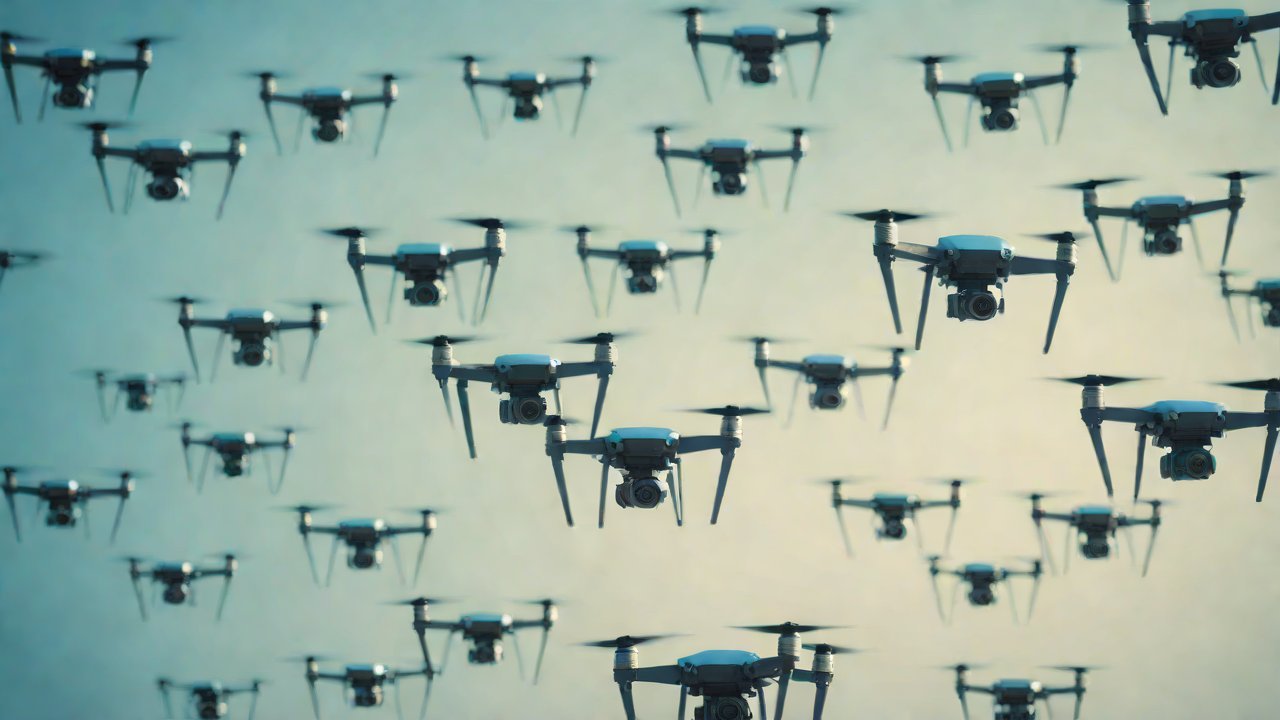
When a drone malfunctions and goes offline, how does the swarm automatically reassign task areas?
A swarm of drones, equipped with advanced Artificial Intelligence and Machine Learning algorithms, can function seamlessly in a coordinated manner, achieving complex tasks with precision and speed. However, when a drone malfunctions and goes offline, the swarm must rapidly adapt and reassess its task areas to ensure mission success. This is where the concept of dynamic task reassignment comes into play, allowing the swarm to automatically redistribute tasks among the remaining drones, minimizing disruptions and ensuring the overall mission objective is achieved.
1. Swarm Architecture and Task Reassignment
A typical swarm architecture consists of multiple drones, each equipped with sensors, communication devices, and a processing unit. The drones are connected through a network, enabling real-time communication and data exchange. When a drone malfunctions and goes offline, the swarm’s central processing unit (CPU) detects the loss of communication and initiates a task reassignment protocol.
The reassignment protocol involves the following steps:
- Task analysis: The CPU analyzes the task requirements and the capabilities of each drone in the swarm.
- Task reassignment: The CPU identifies the tasks that can be reassigned to other drones and redistributes them accordingly.
- Task update: The drones receive the updated task assignments and adjust their flight plans accordingly.
2. Dynamic Task Reassignment Algorithms
The dynamic task reassignment algorithm is a critical component of the swarm’s architecture, responsible for ensuring seamless task redistribution. There are several algorithms used in dynamic task reassignment, including:
2.1. Greedy Algorithm
The Greedy Algorithm is a simple yet effective approach to dynamic task reassignment. It works by assigning tasks to the drone that can complete them the fastest, taking into account factors such as drone speed, payload capacity, and task complexity.
| Algorithm | Description |
|---|---|
| Greedy Algorithm | Assign tasks to the drone that can complete them the fastest |
2.2. Genetic Algorithm
The Genetic Algorithm is a more sophisticated approach to dynamic task reassignment, inspired by the principles of natural selection and genetics. It works by generating a population of possible task assignments and selecting the best one through a process of mutation and selection.
| Algorithm | Description |
|---|---|
| Genetic Algorithm | Generate a population of possible task assignments and select the best one through mutation and selection |
2.3. Ant Colony Optimization Algorithm
The Ant Colony Optimization Algorithm is another popular approach to dynamic task reassignment, inspired by the foraging behavior of ants. It works by simulating the movement of ants as they search for food, using pheromone trails to guide the search process.
| Algorithm | Description |
|---|---|
| Ant Colony Optimization Algorithm | Simulate the movement of ants as they search for food, using pheromone trails to guide the search process |
3. Market Data and AIGC Perspectives
The market for drone swarms and dynamic task reassignment algorithms is growing rapidly, driven by increasing demand for autonomous systems in industries such as logistics, agriculture, and construction.
According to a report by MarketsandMarkets, the global drone market is expected to reach $43.8 billion by 2025, growing at a CAGR of 21.2%. The report also highlights the increasing adoption of drone swarms in various industries, including:
| Industry | Market Size (2020) | CAGR (2020-2025) |
|---|---|---|
| Logistics | $1.4 billion | 25.6% |
| Agriculture | $1.1 billion | 22.1% |
| Construction | $1.5 billion | 20.5% |
From an AIGC perspective, the development of dynamic task reassignment algorithms is crucial for the success of drone swarms in complex environments. According to a report by ResearchAndMarkets, the global AIGC market is expected to reach $13.4 billion by 2025, growing at a CAGR of 34.6%.
4. Challenges and Future Directions
While dynamic task reassignment algorithms have made significant progress in recent years, there are still several challenges to be addressed, including:
- Scalability: As the size of the swarm increases, the complexity of the task reassignment algorithm also increases, making it difficult to scale.
- Real-time processing: The task reassignment algorithm must be able to process tasks in real-time, taking into account factors such as drone speed, payload capacity, and task complexity.
- Communication: The drones must be able to communicate with each other and the central processing unit in real-time, ensuring seamless task reassignment.
To address these challenges, researchers are exploring new approaches to dynamic task reassignment, including:
- Deep learning: Using deep learning algorithms to improve the accuracy and speed of task reassignment.
- Cloud computing: Using cloud computing to offload complex task reassignment tasks from the central processing unit.
- Edge computing: Using edge computing to enable real-time task reassignment on the drones themselves.
In conclusion, the development of dynamic task reassignment algorithms is critical for the success of drone swarms in complex environments. While there are still several challenges to be addressed, researchers are making significant progress in this area, driven by increasing demand for autonomous systems in various industries.
IOT Cloud Platform
IOT Cloud Platform is an IoT portal established by a Chinese IoT company, focusing on technical solutions in the fields of agricultural IoT, industrial IoT, medical IoT, security IoT, military IoT, meteorological IoT, consumer IoT, automotive IoT, commercial IoT, infrastructure IoT, smart warehousing and logistics, smart home, smart city, smart healthcare, smart lighting, etc.
The IoT Cloud Platform blog is a top IoT technology stack, providing technical knowledge on IoT, robotics, artificial intelligence (generative artificial intelligence AIGC), edge computing, AR/VR, cloud computing, quantum computing, blockchain, smart surveillance cameras, drones, RFID tags, gateways, GPS, 3D printing, 4D printing, autonomous driving, etc.