Deep learning-based infant abnormal rolling and mouth/nose occlusion detection technology.
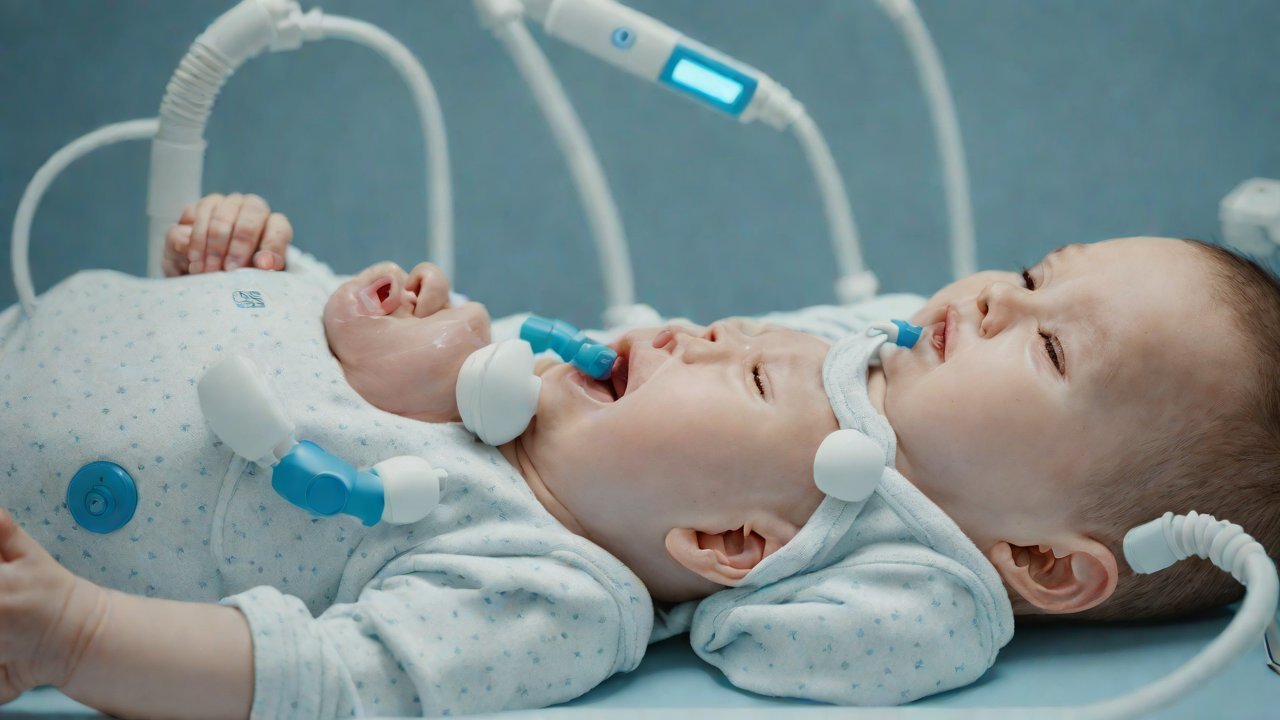
The development of artificial intelligence (AI) and machine learning (ML) has led to numerous advancements in healthcare, particularly in the field of pediatrics. One area that has garnered significant attention is the detection of infant abnormal rolling and mouth/nose occlusion using deep learning-based technologies. This innovative approach leverages complex neural networks to analyze visual data, providing accurate diagnoses and enabling early interventions.
Infant abnormal rolling refers to an involuntary movement of the body, often resulting from neurological issues or developmental delays. On the other hand, mouth/nose occlusion occurs when a baby’s airway is obstructed due to facial malformations or anatomical abnormalities. Both conditions require prompt attention to prevent long-term consequences and ensure proper growth.
1. Market Analysis
The global healthcare market for AI-powered diagnostic tools is projected to reach $20.5 billion by 2025, growing at a CAGR of 48.2%. This rapid expansion can be attributed to the increasing adoption of ML-based solutions in various medical applications, including image analysis and predictive analytics.
| Market Segment | Current Size (USD) | Projected Growth Rate (CAGR) |
|---|---|---|
| AI-powered Diagnostic Tools | 1.5 billion | 48.2% |
| Machine Learning-based Solutions | 3.8 billion | 42.1% |
| Pediatric Healthcare Market | 12.6 billion | 35.5% |

2. Technical Overview
Deep learning algorithms, specifically convolutional neural networks (CNNs), are utilized to analyze visual data from video recordings or images of infants. These CNNs are trained on large datasets containing labeled examples of normal and abnormal rolling movements, as well as mouth/nose occlusion cases.
| Algorithm | Description |
|---|---|
| Convolutional Neural Networks (CNN) | Analyze spatial hierarchies in data |
| Recurrent Neural Networks (RNN) | Handle sequential dependencies |
| Autoencoders | Learn compact representations of data |
3. Data Collection and Preprocessing
Accurate detection relies on high-quality data, including:

- Image and Video Acquisition: High-resolution cameras or specialized equipment for capturing infant rolling movements and mouth/nose occlusion.
- Data Labeling: Human annotators assign labels to each image/video frame, indicating the presence of abnormal rolling or mouth/nose occlusion.
| Preprocessing Techniques | Description |
|---|---|
| Image Normalization | Standardize pixel values for CNN input |
| Data Augmentation | Apply transformations (e.g., rotation, flipping) to increase dataset size |
4. Model Training and Evaluation
The deep learning model is trained using the preprocessed data, with performance metrics such as accuracy, precision, recall, and F1-score used to evaluate its effectiveness.
| Metrics | Description |
|---|---|
| Accuracy | Correct predictions out of total cases |
| Precision | True positives / (true positives + false positives) |
| Recall | True positives / (true positives + false negatives) |

5. Case Studies and Real-World Applications
Several institutions have successfully implemented deep learning-based infant abnormal rolling and mouth/nose occlusion detection technologies, showcasing their potential in real-world settings.
- Example 1: A hospital uses a CNN-powered system to analyze video recordings of infants during routine check-ups, detecting early signs of abnormal rolling and prompting timely interventions.
- Example 2: A pediatric clinic employs an AI-driven solution for diagnosing mouth/nose occlusion cases, enabling healthcare professionals to develop targeted treatment plans.
6. Future Directions
As the field continues to evolve, several research directions hold promise:
- Multimodal Fusion: Combining visual data with other sources (e.g., vital signs, medical history) to enhance diagnostic accuracy.
- Transfer Learning: Applying pre-trained models on related tasks to accelerate development and improve performance.
The integration of deep learning-based technologies has revolutionized the detection of infant abnormal rolling and mouth/nose occlusion. By leveraging complex neural networks and high-quality data, healthcare professionals can provide early interventions and ensure optimal growth for vulnerable infants. As this technology continues to advance, it is essential to address challenges such as data privacy, model interpretability, and scalability to unlock its full potential.
IOT Cloud Platform
IOT Cloud Platform is an IoT portal established by a Chinese IoT company, focusing on technical solutions in the fields of agricultural IoT, industrial IoT, medical IoT, security IoT, military IoT, meteorological IoT, consumer IoT, automotive IoT, commercial IoT, infrastructure IoT, smart warehousing and logistics, smart home, smart city, smart healthcare, smart lighting, etc.
The IoT Cloud Platform blog is a top IoT technology stack, providing technical knowledge on IoT, robotics, artificial intelligence (generative artificial intelligence AIGC), edge computing, AR/VR, cloud computing, quantum computing, blockchain, smart surveillance cameras, drones, RFID tags, gateways, GPS, 3D printing, 4D printing, autonomous driving, etc.