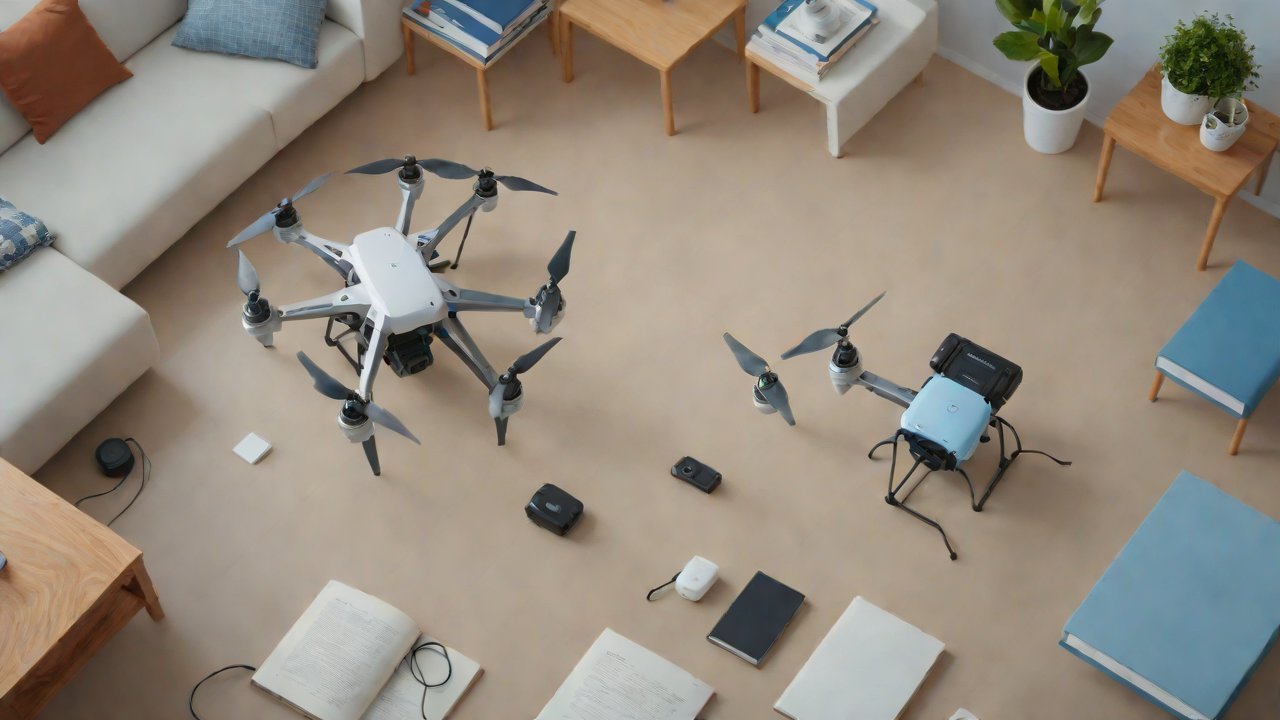
Can this algorithm enable drones to operate completely unattended, like robotic vacuum cleaners?
As we gaze upon the horizon of technological advancements, a fascinating convergence of innovations is taking shape. The realm of drones, once relegated to the realm of hobbyists and enthusiasts, is now poised to transform industries and redefine the notion of autonomy. The tantalizing prospect of drones operating completely unattended, like their diminutive cousins, robotic vacuum cleaners, has sparked a flurry of interest among researchers, developers, and industry stakeholders. This report delves into the feasibility of such an algorithm, exploring the technical, market, and social implications of unattended drone operation.
1. The Rise of Autonomous Drones
Drones, or unmanned aerial vehicles (UAVs), have evolved significantly over the past decade. From their humble beginnings as toy-grade quadcopters to sophisticated, precision-guided aircraft, the industry has witnessed a remarkable acceleration of innovation. Key factors contributing to this growth include:
| Driver | Description |
|---|---|
| Advancements in Sensor Technology | Improved navigation, obstacle avoidance, and environmental sensing capabilities |
| Increased Computing Power | Enhanced processing capabilities for complex algorithms and data analysis |
| Economies of Scale | Reduced production costs and economies of scale, making drones more accessible to consumers and industries |
The proliferation of drones has led to a diverse range of applications, including:
| Sector | Application |
|---|---|
| Agriculture | Crop monitoring, precision farming, and crop yield optimization |
| Construction | Site surveying, inspection, and monitoring |
| Disaster Response | Damage assessment, search and rescue, and emergency response |
2. The Algorithmic Enablers of Autonomous Operation
To achieve unattended drone operation, several algorithmic components are crucial:
- Autonomous Navigation: Integrating sensors, GPS, and machine learning algorithms to enable drones to navigate through complex environments.
- Object Detection and Avoidance: Implementing computer vision and sensor fusion to detect and avoid obstacles, ensuring safe flight.
- Predictive Maintenance: Utilizing data analytics and machine learning to predict and prevent system failures, ensuring prolonged operation.
- Power Management: Developing efficient power management systems to extend flight times and reduce downtime.
3. Market Potential and Competitive Landscape
The market for autonomous drones is expected to experience significant growth, driven by:
| Market Segment | Projected Growth Rate (2023-2028) |
|---|---|
| Commercial Drones | 24.1% |
| Consumer Drones | 14.5% |
Key players in the autonomous drone market include:
| Company | Description |
|---|---|
| DJI | Industry leader in consumer and commercial drones |
| Skydio | Developer of autonomous drone systems for various industries |
| senseFly | Provider of autonomous drone solutions for agriculture and construction |
4. Technical Challenges and Opportunities
While significant progress has been made in developing autonomous drone algorithms, several technical challenges remain:
- Sensor Fusion and Integration: Seamlessly integrating diverse sensors and data sources to achieve robust navigation and object detection.
- Machine Learning and AI: Leveraging machine learning and AI to improve predictive maintenance, power management, and overall system performance.
- Communication and Networking: Developing secure and reliable communication protocols for autonomous drone operation.
5. Regulatory and Social Considerations
As autonomous drones become increasingly prevalent, regulatory frameworks and social implications must be addressed:
- Regulatory Frameworks: Developing and implementing regulations to ensure safe and secure operation.
- Public Acceptance and Awareness: Educating the public about the benefits and risks of autonomous drones.
- Liability and Responsibility: Clarifying liability and responsibility in the event of accidents or system failures.
6. Conclusion
The convergence of technological advancements, market demand, and regulatory considerations has brought us to the cusp of a new era in drone development. The algorithmic enablers of autonomous operation hold tremendous potential for transforming industries and revolutionizing the way we interact with our environment. While technical challenges remain, the rewards of unattended drone operation are too great to ignore. As we move forward, it is essential to balance innovation with responsible development, ensuring that the benefits of autonomous drones are realized while minimizing risks and mitigating negative consequences.
IOT Cloud Platform
IOT Cloud Platform is an IoT portal established by a Chinese IoT company, focusing on technical solutions in the fields of agricultural IoT, industrial IoT, medical IoT, security IoT, military IoT, meteorological IoT, consumer IoT, automotive IoT, commercial IoT, infrastructure IoT, smart warehousing and logistics, smart home, smart city, smart healthcare, smart lighting, etc.
The IoT Cloud Platform blog is a top IoT technology stack, providing technical knowledge on IoT, robotics, artificial intelligence (generative artificial intelligence AIGC), edge computing, AR/VR, cloud computing, quantum computing, blockchain, smart surveillance cameras, drones, RFID tags, gateways, GPS, 3D printing, 4D printing, autonomous driving, etc.