Space Breeding IoT: What’s Different About Plant Data in Weightlessness?
In the vast expanse of space, where gravity is a distant memory and the air is a precious commodity, scientists are pushing the boundaries of life as we know it. One of the most intriguing areas of research is plant growth in weightlessness, where the fundamental principles of botany are rewritten. As the Internet of Things (IoT) continues to revolutionize our understanding of the natural world, the intersection of space breeding and IoT has given rise to a new frontier: Space Breeding IoT.
1. The Challenges of Plant Growth in Weightlessness
Plant growth in weightlessness is a complex phenomenon that defies many of the established rules of botany. In microgravity environments, plants exhibit altered morphology, physiology, and biochemistry compared to their Earth-bound counterparts. For instance, studies have shown that Arabidopsis thaliana (a common model organism) grown in space exhibits reduced root growth, increased cell elongation, and modified gene expression.
| Plant Species | Weightlessness Effects |
|---|---|
| Arabidopsis thaliana | Reduced root growth, increased cell elongation |
| Zea mays (Corn) | Altered leaf morphology, decreased biomass production |
| Solanum lycopersicum (Tomato) | Increased fruit size, altered sugar composition |
2. The Role of IoT in Space Breeding
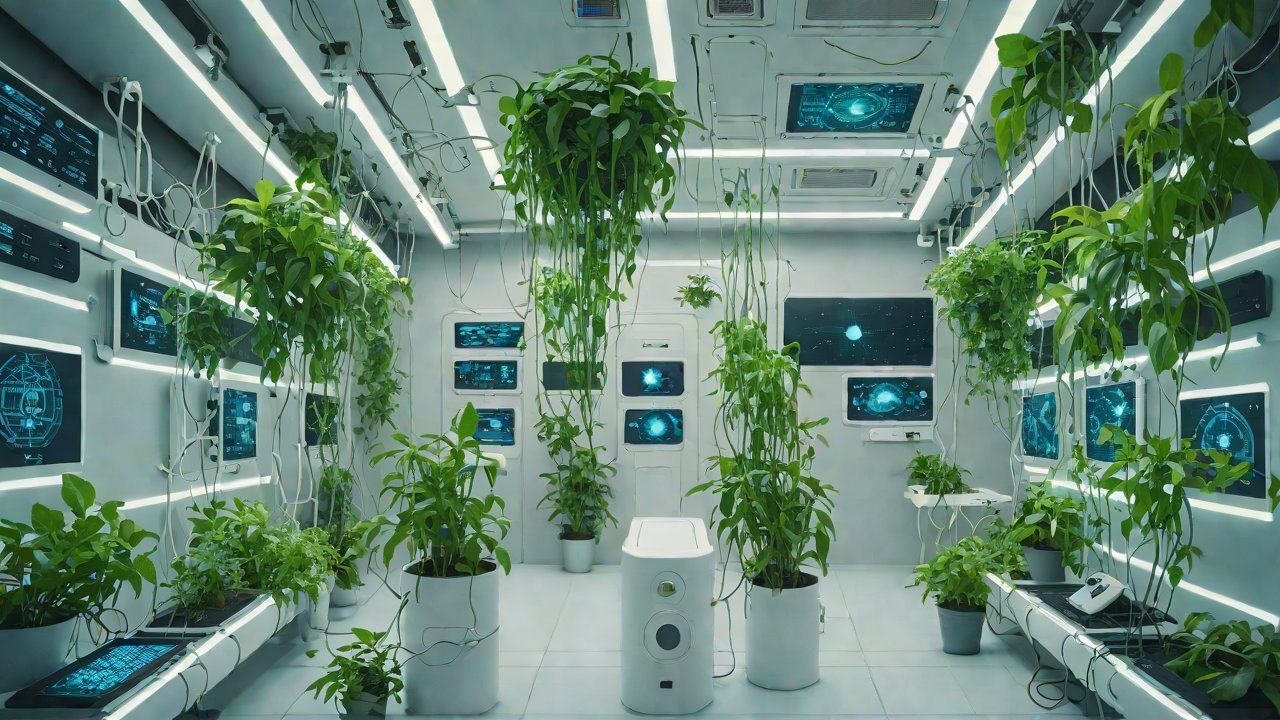
The IoT has emerged as a crucial tool for monitoring and understanding plant growth in space. Advanced sensors and data analytics enable researchers to track subtle changes in plant physiology, detect early signs of stress or disease, and optimize growing conditions. For instance, the European Space Agency’s (ESA) MELISSA project uses IoT sensors to monitor CO2 levels, temperature, and humidity in controlled environment agriculture systems.
| Sensor Type | Application |
|---|---|
| Photosynthetic Active Radiation (PAR) Sensors | Monitor light intensity and spectrum |
| Temperature and Humidity Sensors | Control environmental conditions |
| CO2 Sensors | Optimize carbon dioxide levels |

3. AIGC Perspectives on Plant Data in Weightlessness
Artificial Intelligence and Generative Computer (AIGC) models are being explored for their potential to analyze and interpret plant data from space breeding experiments. These models can identify patterns and correlations that would be difficult or impossible for humans to discern, providing valuable insights into the complex interactions between plants, environment, and microgravity.
| AIGC Model | Application |
|---|---|
| Recurrent Neural Networks (RNNs) | Predict plant growth rates and biomass production |
| Convolutional Neural Networks (CNNs) | Analyze high-resolution images of plant morphology |
| Generative Adversarial Networks (GANs) | Simulate plant growth in various environmental conditions |
4. Market Analysis: Space Breeding IoT
The market for space breeding IoT is expected to experience significant growth in the coming years, driven by increasing investment in space exploration and research initiatives. According to a report by ResearchAndMarkets.com, the global space-based agriculture market is projected to reach $1.3 billion by 2025.
| Market Segment | Estimated Value (2025) |
|---|---|
| Space-Based Agriculture | $1.3 billion |
| In-Orbit Manufacturing | $500 million |
| Space Tourism and Recreation | $200 million |
5. Technical Challenges and Opportunities
As the space breeding IoT industry continues to evolve, several technical challenges must be addressed. These include developing robust sensors that can withstand the harsh conditions of space, creating secure data transmission protocols for remote monitoring, and ensuring the scalability of IoT systems in microgravity environments.
| Technical Challenge | Solution Opportunity |
|---|---|
| Sensor Development | Advanced materials and nanotechnology |
| Data Transmission | Quantum encryption and satellite-based communication |
| Scalability | Modular and distributed IoT architectures |
6. Conclusion
The intersection of space breeding and IoT has given rise to a new frontier in plant research, where the boundaries between Earth and space are being rewritten. As we continue to push the limits of life in weightlessness, the insights gained from Space Breeding IoT will have far-reaching implications for food security, sustainable agriculture, and our understanding of the natural world.
However, the technical challenges and market opportunities that arise from this research must be addressed through innovative solutions and strategic investments. By harnessing the power of AIGC and IoT technologies, we can unlock the secrets of plant growth in space and create a new era of space-based agriculture.
IOT Cloud Platform
IOT Cloud Platform is an IoT portal established by a Chinese IoT company, focusing on technical solutions in the fields of agricultural IoT, industrial IoT, medical IoT, security IoT, military IoT, meteorological IoT, consumer IoT, automotive IoT, commercial IoT, infrastructure IoT, smart warehousing and logistics, smart home, smart city, smart healthcare, smart lighting, etc.
The IoT Cloud Platform blog is a top IoT technology stack, providing technical knowledge on IoT, robotics, artificial intelligence (generative artificial intelligence AIGC), edge computing, AR/VR, cloud computing, quantum computing, blockchain, smart surveillance cameras, drones, RFID tags, gateways, GPS, 3D printing, 4D printing, autonomous driving, etc.