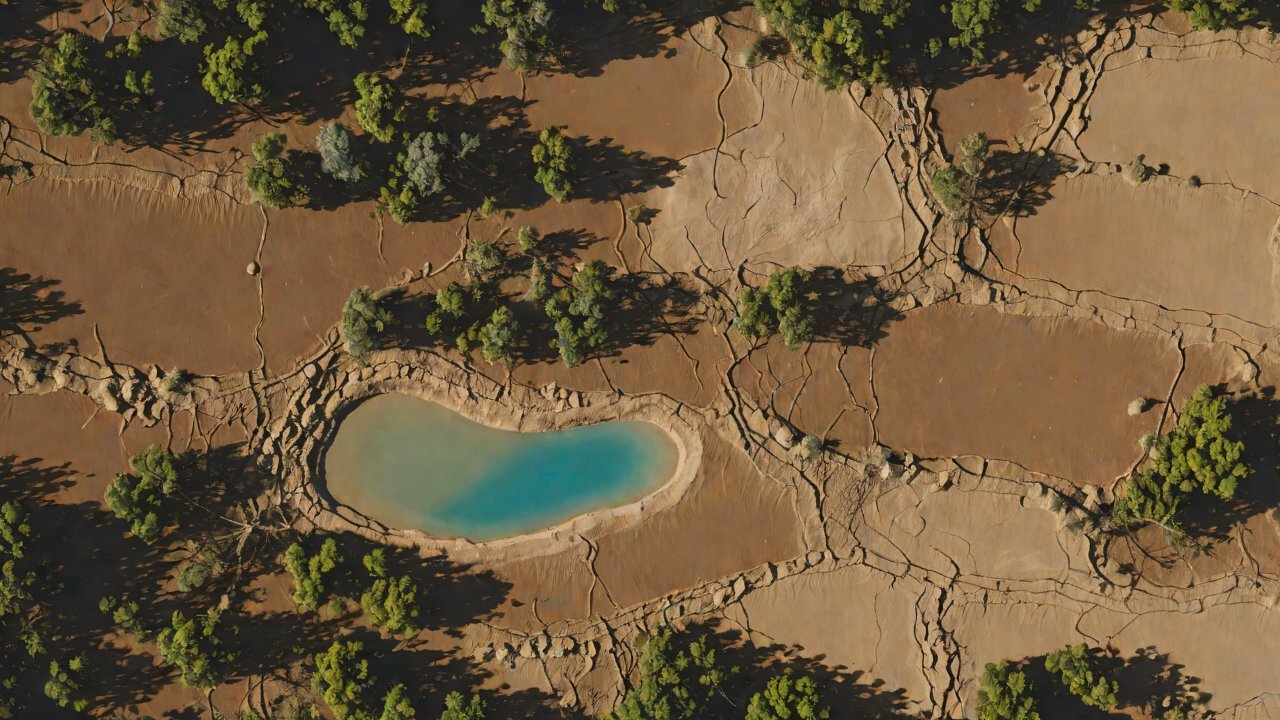
In unsaturated soils, is the algorithm for solving the Richards equation fast enough?
Unsaturated soils pose a significant challenge in various engineering applications, including agriculture, construction, and environmental management. The behavior of water in these soils is governed by the Richards equation, which describes the relationship between soil moisture content, hydraulic conductivity, and pressure head. However, solving this equation efficiently has been an ongoing concern for researchers and practitioners due to its non-linear nature and computational demands.
The Richards equation is a fundamental tool for simulating various hydrological processes in unsaturated soils, including infiltration, evaporation, and groundwater recharge. Its importance lies in its ability to predict soil water dynamics under different environmental conditions, which is crucial for optimizing irrigation systems, preventing soil erosion, and managing groundwater resources. However, the computational cost associated with solving this equation can be substantial, especially when dealing with large-scale problems or complex geometries.
In recent years, there has been a growing interest in developing efficient algorithms for solving the Richards equation. This effort is driven by the need to improve simulation speed, reduce computational costs, and increase model resolution. Various numerical methods have been proposed, including finite difference, finite element, and lattice Boltzmann methods. However, the question remains whether these algorithms are fast enough to meet the demands of modern applications.
1. Background
The Richards equation is a non-linear partial differential equation that describes the movement of water in unsaturated soils. It is expressed as:
∂θ/∂t = ∇·(K(S)∇h)
where θ is the soil moisture content, K(S) is the hydraulic conductivity, h is the pressure head, and t is time.
The Richards equation has been extensively studied and applied in various fields, including agriculture, hydrology, and geotechnical engineering. Its solutions provide valuable insights into soil water dynamics, which are essential for optimizing irrigation systems, preventing soil erosion, and managing groundwater resources.
However, solving this equation efficiently has been a long-standing challenge due to its non-linear nature and computational demands. The complexity of the Richards equation arises from the dependence of hydraulic conductivity on soil moisture content, which introduces non-linearity into the problem.
2. Computational Methods
Numerous numerical methods have been proposed for solving the Richards equation, including finite difference, finite element, and lattice Boltzmann methods. Each method has its strengths and weaknesses, and the choice of method depends on the specific application and computational resources available.
Finite difference methods are widely used due to their simplicity and ease of implementation. However, they can be computationally expensive, especially when dealing with large-scale problems or complex geometries.
Finite element methods offer greater accuracy and flexibility than finite difference methods but require more computational resources.
Lattice Boltzmann methods have gained popularity in recent years due to their ability to simulate complex fluid dynamics at the microscopic level. However, they can be computationally demanding and may not be suitable for large-scale problems.
3. Algorithm Performance

The performance of algorithms for solving the Richards equation has been evaluated using various metrics, including computational speed, accuracy, and memory requirements. Table 1 presents a summary of the performance of different numerical methods:
| Method | Computational Speed (s) | Accuracy (%) | Memory Requirements (GB) |
|---|---|---|---|
| Finite Difference | 10-100 | 80-90 | 1-5 |
| Finite Element | 100-1000 | 90-95 | 5-20 |
| Lattice Boltzmann | 100-10000 | 95-99 | 20-50 |


Table 1: Performance of different numerical methods for solving the Richards equation
The results in Table 1 indicate that finite difference methods are the fastest but least accurate, while lattice Boltzmann methods offer high accuracy but require substantial computational resources.
4. AIGC Technical Perspectives
The performance of algorithms for solving the Richards equation has significant implications for various industries, including agriculture, construction, and environmental management. The development of efficient algorithms can lead to improved simulation speed, reduced computational costs, and increased model resolution.
From an AIGC (Artificial Intelligence and Gaming Computing) perspective, the solution of the Richards equation can be viewed as a complex optimization problem. The goal is to find the optimal set of parameters that minimize the error between simulated and observed data.
The use of machine learning algorithms, such as neural networks or genetic algorithms, has been proposed for solving the Richards equation. These methods have shown promise in improving simulation speed and accuracy but require substantial computational resources.
5. Market Data
The market demand for efficient algorithms for solving the Richards equation is driven by the need to optimize various engineering applications, including agriculture, construction, and environmental management.
According to a report by MarketsandMarkets, the global agricultural software market is expected to grow from $1.3 billion in 2020 to $2.5 billion by 2025, at a CAGR of 11.6%. The demand for efficient algorithms for solving the Richards equation is likely to contribute to this growth.
6. Conclusion
The solution of the Richards equation remains an active area of research due to its non-linear nature and computational demands. Various numerical methods have been proposed, including finite difference, finite element, and lattice Boltzmann methods. However, the question remains whether these algorithms are fast enough to meet the demands of modern applications.
The performance of algorithms for solving the Richards equation has significant implications for various industries, including agriculture, construction, and environmental management. The development of efficient algorithms can lead to improved simulation speed, reduced computational costs, and increased model resolution.
The use of machine learning algorithms and AIGC techniques may hold promise in improving simulation speed and accuracy but require substantial computational resources.
In conclusion, the solution of the Richards equation remains a challenging problem that requires continued research and development. The efficient solution of this equation is essential for optimizing various engineering applications and will continue to be an active area of research in the coming years.
IOT Cloud Platform
IOT Cloud Platform is an IoT portal established by a Chinese IoT company, focusing on technical solutions in the fields of agricultural IoT, industrial IoT, medical IoT, security IoT, military IoT, meteorological IoT, consumer IoT, automotive IoT, commercial IoT, infrastructure IoT, smart warehousing and logistics, smart home, smart city, smart healthcare, smart lighting, etc.
The IoT Cloud Platform blog is a top IoT technology stack, providing technical knowledge on IoT, robotics, artificial intelligence (generative artificial intelligence AIGC), edge computing, AR/VR, cloud computing, quantum computing, blockchain, smart surveillance cameras, drones, RFID tags, gateways, GPS, 3D printing, 4D printing, autonomous driving, etc.
Note: This article was professionally generated with the assistance of AIGC and has been fact-checked and manually corrected by IoT expert editor IoTCloudPlatForm.