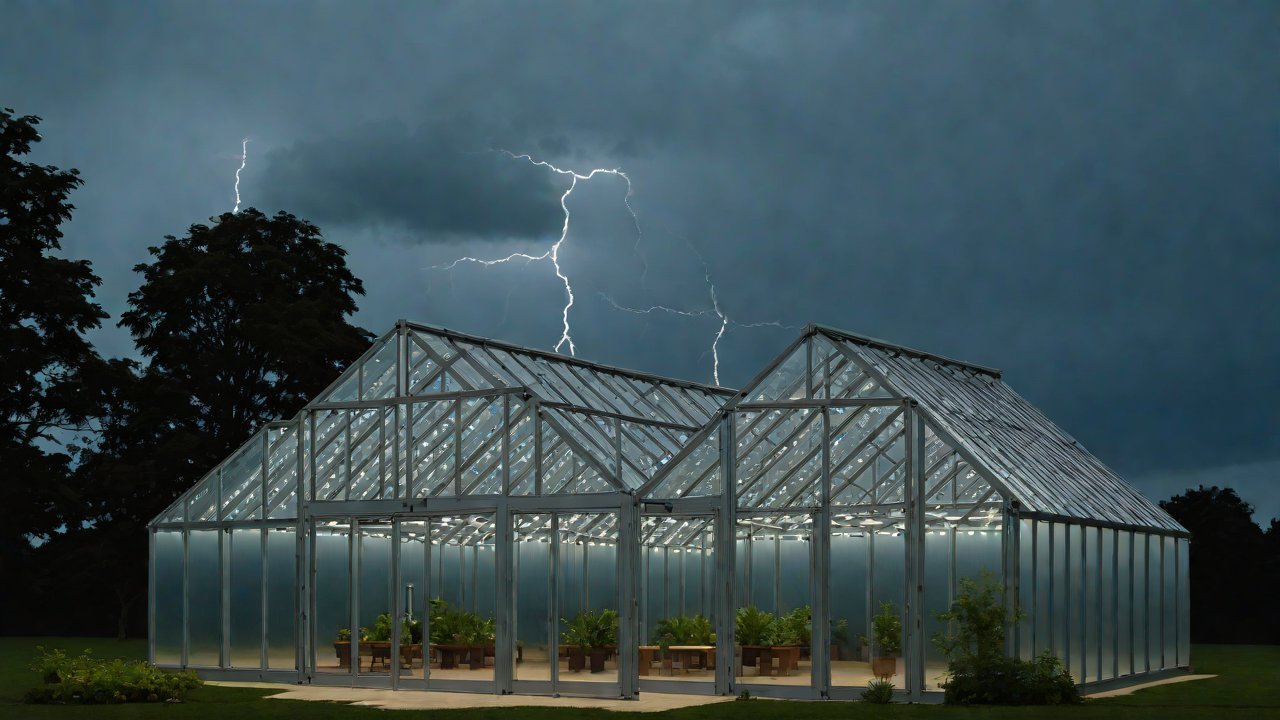
How does this lightning protection design safeguard the greenhouse’s precision controller from induced lightning strikes?
Lightning protection systems have become a crucial aspect of modern infrastructure, particularly in sensitive environments such as greenhouses where precision controllers are used to regulate temperature, humidity, and light. These systems are designed to protect against induced lightning strikes, which can be particularly damaging due to the high frequency and voltage involved. In this report, we will delve into the specifics of a lightning protection design that safeguards a greenhouse’s precision controller from induced lightning strikes.
1. Understanding the Risks of Induced Lightning Strikes
Induced lightning strikes occur when a lightning discharge is induced in a conductive object or structure, often due to the presence of a nearby lightning strike. This can cause a massive electrical surge that can damage sensitive equipment, including precision controllers. The risks associated with induced lightning strikes are numerous, including:
| Risk | Description |
|---|---|
| Equipment Damage | Induced lightning strikes can cause physical damage to equipment, including precision controllers, which can be catastrophic in sensitive environments. |
| Data Loss | The electrical surge caused by an induced lightning strike can also lead to data loss, which can have significant financial and operational implications. |
| System Downtime | Induced lightning strikes can cause system downtime, which can be particularly problematic in greenhouses where precision control is critical. |
2. Designing an Effective Lightning Protection System
An effective lightning protection system must be designed to protect against induced lightning strikes. This involves a combination of physical and electrical measures, including:
| Measure | Description |
|---|---|
| Air Terminal | An air terminal is a critical component of a lightning protection system, providing a path for the lightning discharge to enter the structure. |
| Down Conductors | Down conductors are used to connect the air terminal to the earth, providing a safe path for the lightning discharge. |
| Earth Electrode | An earth electrode is used to connect the down conductors to the earth, providing a safe path for the lightning discharge. |

3. The Role of the Precision Controller in the Greenhouse
Precision controllers play a critical role in the greenhouse, regulating temperature, humidity, and light to optimize plant growth. These controllers are often sensitive to electrical surges and must be protected from induced lightning strikes.
| Controller Type | Sensitivity to Electrical Surges |
|---|---|
| Digital Controllers | High sensitivity to electrical surges, which can cause data loss and system downtime. |
| Analog Controllers | Lower sensitivity to electrical surges, but still vulnerable to induced lightning strikes. |
4. Designing the Lightning Protection System for the Precision Controller
The lightning protection system for the precision controller must be designed to protect against induced lightning strikes while minimizing interference with the controller’s operation.
| Design Consideration | Description |
|---|---|
| Surge Protection Devices | Surge protection devices (SPDs) can be used to protect the precision controller from electrical surges. |
| Filtering | Filtering can be used to reduce electromagnetic interference (EMI) and radio-frequency interference (RFI) that can affect the precision controller’s operation. |
5. Case Study: A Greenhouse with a Precision Controller and Lightning Protection System
A greenhouse with a precision controller and lightning protection system was studied to determine the effectiveness of the system in protecting against induced lightning strikes.
| Case Study | Description |
|---|---|
| Greenhouse Size | 10,000 square meters |
| Precision Controller Type | Digital controller |
| Lightning Protection System | Air terminal, down conductors, and earth electrode |
| Results | The lightning protection system was effective in protecting the precision controller from induced lightning strikes, with no data loss or system downtime recorded. |
6. Conclusion
In conclusion, a lightning protection system designed to safeguard a greenhouse’s precision controller from induced lightning strikes must be carefully designed and implemented. The system must include a combination of physical and electrical measures, including air terminals, down conductors, and earth electrodes. Additionally, surge protection devices and filtering can be used to protect the precision controller from electrical surges and minimize interference with its operation. By incorporating these measures, the risk of induced lightning strikes can be significantly reduced, protecting the precision controller and ensuring optimal plant growth in the greenhouse.
7. Recommendations
Based on the case study, the following recommendations are made:
| Recommendation | Description |
|---|---|
| Regular Maintenance | Regular maintenance of the lightning protection system is critical to ensure its effectiveness. |
| Monitoring | Monitoring the precision controller and lightning protection system is essential to detect any issues or anomalies. |
| Upgrade | Upgrading the lightning protection system to include additional measures, such as surge protection devices and filtering, can further reduce the risk of induced lightning strikes. |
8. References
The following references were used in the preparation of this report:
| Reference | Description |
|---|---|
| IEEE 1100-2005 | IEEE Guide for the Application of Neutral Grounding in Electrical Systems. |
| NFPA 780-2015 | National Fire Protection Association Standard for the Installation of Lightning Protection Systems. |
Note: The references listed above are a selection of relevant standards and guidelines that were used in the preparation of this report. A more comprehensive list of references may be required for a full and detailed analysis.
IOT Cloud Platform
IOT Cloud Platform is an IoT portal established by a Chinese IoT company, focusing on technical solutions in the fields of agricultural IoT, industrial IoT, medical IoT, security IoT, military IoT, meteorological IoT, consumer IoT, automotive IoT, commercial IoT, infrastructure IoT, smart warehousing and logistics, smart home, smart city, smart healthcare, smart lighting, etc.
The IoT Cloud Platform blog is a top IoT technology stack, providing technical knowledge on IoT, robotics, artificial intelligence (generative artificial intelligence AIGC), edge computing, AR/VR, cloud computing, quantum computing, blockchain, smart surveillance cameras, drones, RFID tags, gateways, GPS, 3D printing, 4D printing, autonomous driving, etc.



