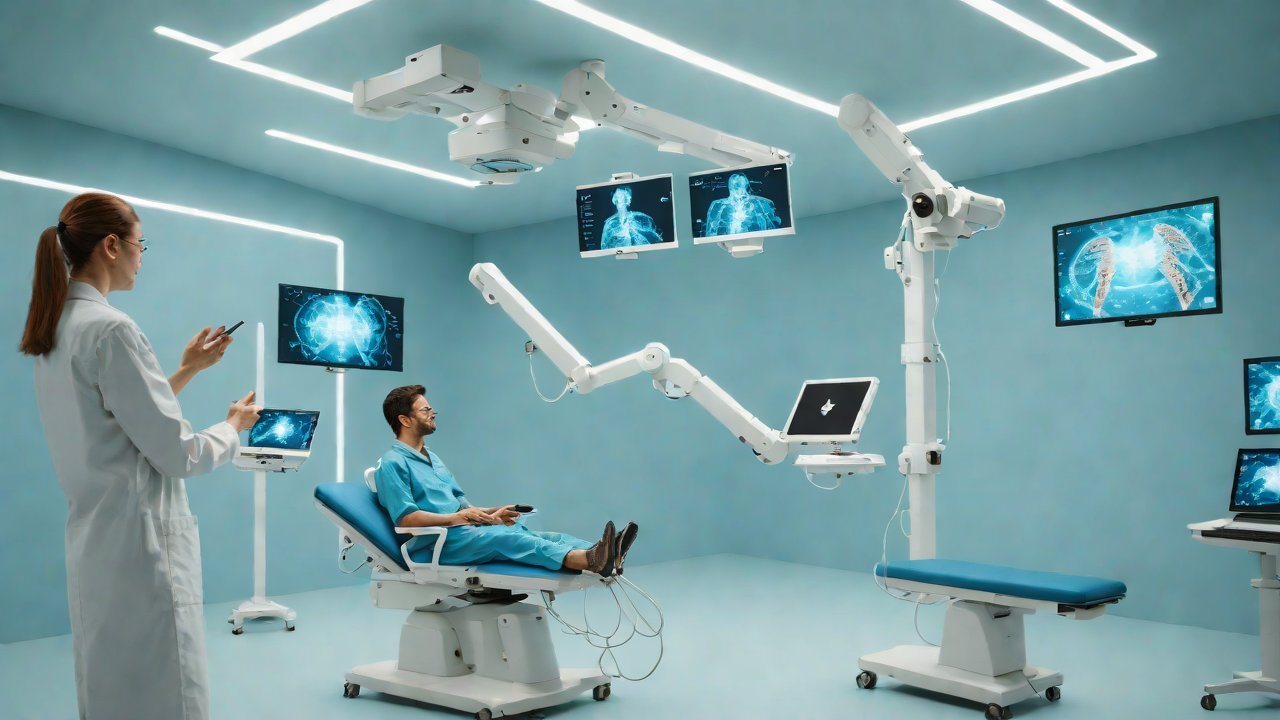
How can this virtual clinic use AR technology to display 3D pathological models?
Virtual Clinics and Augmented Reality: Revolutionizing Pathological Model Visualization
As the healthcare industry continues to grapple with the complexities of disease diagnosis, treatment, and patient education, innovative technologies are being leveraged to improve outcomes and enhance patient experiences. Virtual clinics, which utilize digital platforms to provide remote consultations and care services, are no exception. One promising area of exploration involves the integration of Augmented Reality (AR) technology to display 3D pathological models, allowing medical professionals to better understand and communicate complex anatomical and pathological information to patients.
1. Current Challenges in Pathological Model Visualization
Traditional methods for visualizing pathological models rely heavily on static images, diagrams, or 2D projections, which can be limiting in terms of their ability to convey intricate details and spatial relationships. These limitations can lead to misunderstandings between healthcare providers and patients, potentially resulting in misdiagnoses, delayed treatment, or inadequate patient education.
| Challenge | Description |
|---|---|
| Limited spatial understanding | 2D images struggle to convey complex spatial relationships between anatomical structures |
| Inadequate detail | Static images often lack the level of detail required for accurate diagnosis and treatment planning |
| Miscommunication | Difficulty in conveying complex information to patients, leading to misunderstandings and misdiagnoses |
2. Augmented Reality: A Solution for Enhanced Visualization
Augmented Reality (AR) technology has emerged as a powerful tool for enhancing visualization and interaction with digital content. By overlaying virtual information onto real-world environments or objects, AR enables users to engage with complex data in a more intuitive and immersive manner.
| AR Advantages | Description |
|---|---|
| Enhanced spatial understanding | 3D models allow for accurate spatial relationships between anatomical structures to be understood |
| Increased detail | High-resolution 3D models provide unparalleled levels of detail, facilitating accurate diagnosis and treatment planning |
| Improved communication | AR enables healthcare providers to effectively communicate complex information to patients, reducing misunderstandings and misdiagnoses |
3. Implementing AR in Virtual Clinics
To integrate AR technology into virtual clinics for the display of 3D pathological models, several key considerations must be taken into account:
- Hardware Requirements: High-performance computing hardware, such as specialized graphics processing units (GPUs) or augmented reality capable devices, will be necessary to render high-quality 3D models in real-time.
- Software Development: Custom software applications will need to be developed to integrate AR functionality with the virtual clinic platform, ensuring seamless user experience and efficient data transfer between systems.
| Implementation Considerations | Description |
|---|---|
| Hardware requirements | High-performance computing hardware necessary for rendering high-quality 3D models in real-time |
| Software development | Custom software applications required to integrate AR functionality with virtual clinic platform |
4. Market Opportunities and Future Directions
The integration of AR technology into virtual clinics for the display of 3D pathological models presents significant market opportunities, including:
- Increased Adoption: Growing demand for remote healthcare services and increased adoption of AR technology in various industries are expected to drive growth in this sector.
- Improved Patient Outcomes: Enhanced visualization capabilities through AR technology have the potential to improve patient outcomes by facilitating more accurate diagnoses and treatment plans.
| Market Opportunities | Description |
|---|---|
| Increased adoption | Growing demand for remote healthcare services and increased adoption of AR technology in various industries |
| Improved patient outcomes | Enhanced visualization capabilities through AR technology expected to improve patient outcomes |
5. Technical Perspectives: Challenges and Future Developments
Several technical challenges must be addressed when implementing AR technology in virtual clinics, including:
- Data Integration: Seamless integration of medical imaging data with AR software applications will be crucial for accurate model creation and visualization.
- User Interface Design: Intuitive user interfaces will be essential to ensure healthcare providers and patients can effectively interact with 3D models.
| Technical Challenges | Description |
|---|---|
| Data integration | Seamless integration of medical imaging data with AR software applications required for accurate model creation and visualization |
| User interface design | Intuitive user interfaces necessary to facilitate effective interaction with 3D models |
6. Conclusion
The integration of Augmented Reality (AR) technology into virtual clinics for the display of 3D pathological models presents a promising opportunity to revolutionize pathological model visualization, improving patient outcomes and enhancing communication between healthcare providers and patients. Addressing technical challenges through software development and hardware requirements will be crucial in realizing this vision.
| Conclusion | Description |
|---|---|
| AR technology potential | Revolutionizing pathological model visualization, improving patient outcomes, and enhancing communication between healthcare providers and patients |
As the healthcare industry continues to evolve, it is essential for medical professionals, researchers, and technologists to collaborate in exploring innovative solutions that leverage cutting-edge technologies like AR. By harnessing the power of AR, virtual clinics can provide more effective care services, ultimately leading to better patient outcomes and improved quality of life.
IOT Cloud Platform
IOT Cloud Platform is an IoT portal established by a Chinese IoT company, focusing on technical solutions in the fields of agricultural IoT, industrial IoT, medical IoT, security IoT, military IoT, meteorological IoT, consumer IoT, automotive IoT, commercial IoT, infrastructure IoT, smart warehousing and logistics, smart home, smart city, smart healthcare, smart lighting, etc.
The IoT Cloud Platform blog is a top IoT technology stack, providing technical knowledge on IoT, robotics, artificial intelligence (generative artificial intelligence AIGC), edge computing, AR/VR, cloud computing, quantum computing, blockchain, smart surveillance cameras, drones, RFID tags, gateways, GPS, 3D printing, 4D printing, autonomous driving, etc.