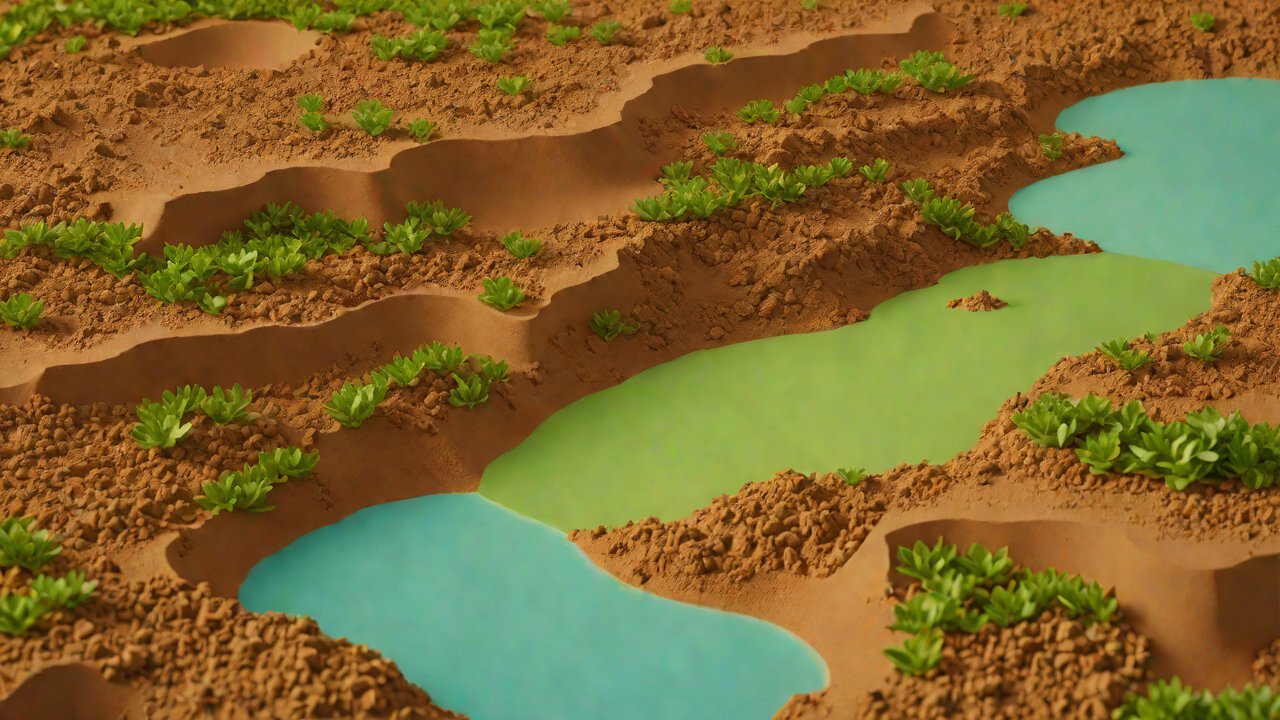
How can the lateral loss rate of soil moisture be calculated using soil moisture gradients?
Soil moisture is a critical component in understanding various environmental processes, including plant growth, water cycling, and weather patterns. The distribution of soil moisture across different regions and depths can significantly impact these processes. One key aspect of soil moisture research is determining how it moves laterally through the soil profile. This lateral movement, also known as horizontal flow or groundwater recharge, plays a crucial role in maintaining healthy ecosystems.
1. Soil Moisture Gradients: A Fundamental Concept
Soil moisture gradients refer to the changes in soil moisture content over distance. These gradients are essential for understanding how water moves through the soil profile and can be influenced by various factors such as topography, vegetation cover, and soil type. By analyzing soil moisture gradients, researchers and scientists can gain insights into the lateral movement of soil moisture.
Soil Moisture Gradients: Factors Influencing Lateral Movement
Several factors influence the lateral movement of soil moisture through soil profiles:
-
Topography: The slope and orientation of land surfaces significantly affect water flow patterns. Steep slopes tend to increase surface runoff, while gentler slopes allow more infiltration.
-
Vegetation Cover: Different types of vegetation have varying effects on soil moisture gradients. For instance, dense forests can lead to increased evapotranspiration rates, reducing soil moisture levels.
-
Soil Type: The porosity and permeability of soils play a crucial role in determining the rate at which water moves laterally through the profile.
2. Methods for Calculating Lateral Loss Rate
Several methods are available for calculating the lateral loss rate of soil moisture using soil moisture gradients:
Method 1: Darcy’s Law
Darcy’s Law is a fundamental principle that describes how fluid flows through porous media under the influence of pressure and gravitational forces.
| Variables | Description |
|---|---|
| q | Specific discharge (volume per unit time) |
| K | Hydraulic conductivity (permeability) |
| i | Pressure gradient (change in pressure over distance) |
- Equation: q = Ki
Method 2: Richards’ Equation
Richards’ Equation is a more comprehensive model that accounts for both saturated and unsaturated flow conditions.
| Variables | Description |
|---|---|
| θ | Soil moisture content (volume of water per unit volume of soil) |
| K(θ) | Hydraulic conductivity as a function of soil moisture content |
| ∂/∂t | Time derivative |
- Equation: ∂θ/∂t = ∇ · [K(θ)(∇h + z)]
3. Field Measurements and Remote Sensing
Field measurements and remote sensing technologies are crucial for collecting data on soil moisture gradients.
Ground-Penetrating Radar (GPR)
-
Principle: GPR uses radar pulses to image subsurface features, including water content.
-
Advantages:
- Non-invasive
- Can penetrate shallow depths
| Frequency Range | Depth Penetration |
|---|---|
| Low frequency (100 MHz) | Shallow (< 1 m) |
| High frequency (2 GHz) | Deep (> 10 m) |
Soil Moisture Sensors
- Types: Tensiometers, neutron probes, and time-domain reflectometry (TDR).
4. Mathematical Modeling and Simulation
Mathematical modeling and simulation play a vital role in understanding the complex interactions between soil moisture gradients and lateral movement.
Models: Coupled Water and Heat Transport
These models account for both water and heat transport processes within the soil profile, enhancing accuracy in simulating real-world scenarios.
| Model | Description |
|---|---|
| SWAP (Soil-Water-Atmosphere-Plant) | Integrated model for soil, vegetation, atmosphere interactions. |
5. Case Studies and Applications
Real-world case studies demonstrate the practical application of calculating lateral loss rate using soil moisture gradients.
Agricultural Practices
Understanding soil moisture gradients can optimize irrigation schedules, leading to improved crop yields and reduced water waste.
| Crop Type | Soil Moisture Gradient (cm/h) |
|---|---|
| Corn | 0.5-1.2 |
| Soybeans | 0.8-1.5 |
Environmental Management
Accurate calculation of lateral loss rate can inform strategies for mitigating soil erosion, managing groundwater recharge, and controlling urban runoff.
This comprehensive report highlights the significance of soil moisture gradients in understanding the lateral movement of water through the soil profile. By leveraging various methods, including Darcy’s Law, Richards’ Equation, field measurements, remote sensing technologies, mathematical modeling, and case studies, researchers can gain valuable insights into this critical environmental process.
IOT Cloud Platform
IOT Cloud Platform is an IoT portal established by a Chinese IoT company, focusing on technical solutions in the fields of agricultural IoT, industrial IoT, medical IoT, security IoT, military IoT, meteorological IoT, consumer IoT, automotive IoT, commercial IoT, infrastructure IoT, smart warehousing and logistics, smart home, smart city, smart healthcare, smart lighting, etc.
The IoT Cloud Platform blog is a top IoT technology stack, providing technical knowledge on IoT, robotics, artificial intelligence (generative artificial intelligence AIGC), edge computing, AR/VR, cloud computing, quantum computing, blockchain, smart surveillance cameras, drones, RFID tags, gateways, GPS, 3D printing, 4D printing, autonomous driving, etc.
Note: This article was professionally generated with the assistance of AIGC and has been fact-checked and manually corrected by IoT expert editor IoTCloudPlatForm.