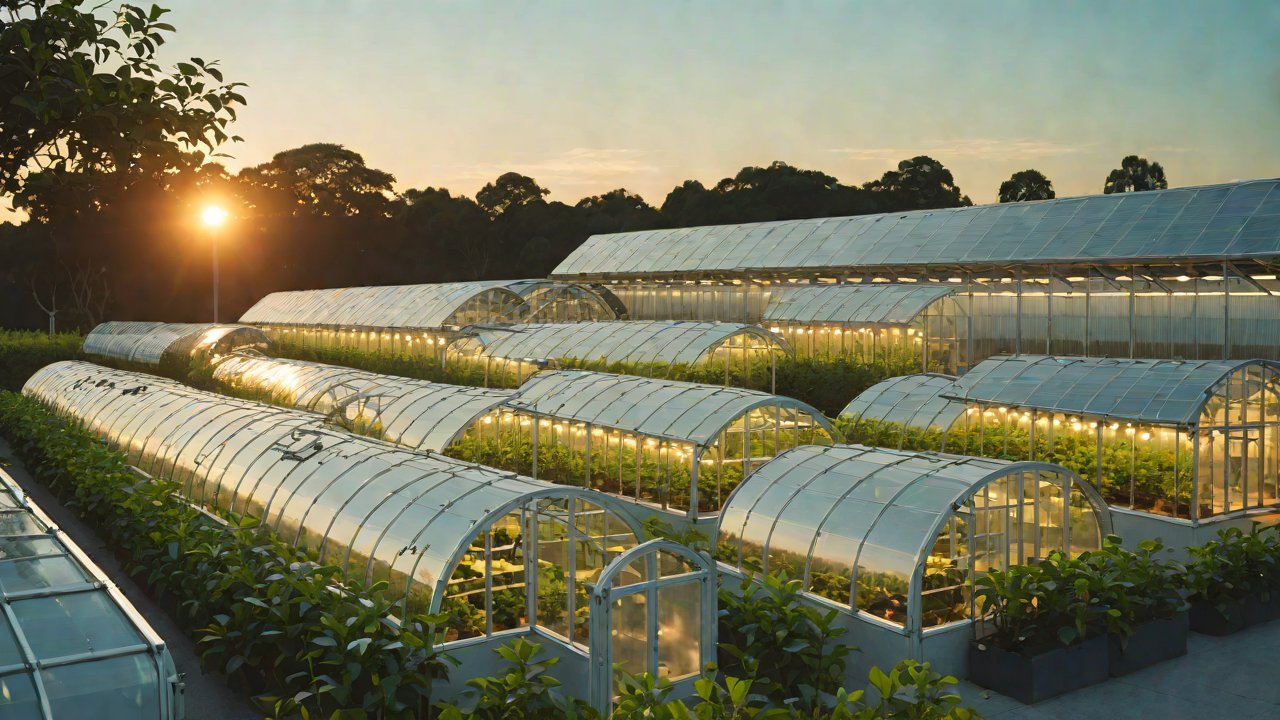
How can neural networks simulate the complex nonlinear thermodynamic processes inside a greenhouse?
The intricate dance of thermodynamic processes within a greenhouse is a complex phenomenon that has puzzled scientists and engineers for centuries. As the world grapples with the challenges of climate change, sustainable agriculture, and energy efficiency, simulating these processes has become a pressing concern. Neural networks, with their unparalleled ability to model and predict nonlinear dynamics, offer a promising solution. In this report, we will delve into the world of neural networks and explore how they can be used to simulate the complex thermodynamic processes inside a greenhouse.
1. Understanding Greenhouse Thermodynamics
A greenhouse is a controlled environment where plants are grown under conditions of high temperatures and humidity. The thermodynamic processes within a greenhouse are governed by the principles of heat transfer, mass transfer, and energy balance. The greenhouse is a complex system, comprising multiple interacting components, including the glass or plastic cover, the frame, the plants, the soil, and the air. These components interact through various mechanisms, such as radiation, convection, and conduction, resulting in a dynamic and nonlinear system.
| Component | Description | Function |
|---|---|---|
| Glass/Plastic Cover | Transparent material allowing solar radiation to enter | Allows solar radiation to enter while preventing heat loss |
| Frame | Structural support for the cover | Provides structural support for the cover |
| Plants | Biological organisms absorbing CO2 and releasing O2 | Absorbs CO2 and releases O2 |
| Soil | Medium for plant growth | Provides nutrients and water for plant growth |
| Air | Gas mixture containing CO2, O2, and N2 | Transports heat, mass, and energy within the greenhouse |

2. Neural Network Fundamentals
Neural networks are a type of machine learning algorithm inspired by the structure and function of the human brain. They consist of interconnected nodes or “neurons” that process and transmit information. Neural networks have been successfully applied to a wide range of problems, including image recognition, natural language processing, and time series forecasting. In the context of greenhouse thermodynamics, neural networks can be used to model and predict the complex interactions between the various components.
| Neural Network Type | Description | Application |
|---|---|---|
| Feedforward Network | Simplest type of neural network, where information flows only in one direction | Used for regression and classification tasks |
| Recurrent Neural Network (RNN) | Type of neural network capable of handling sequential data | Used for time series forecasting and modeling dynamic systems |
| Long Short-Term Memory (LSTM) | Special type of RNN that can handle long-term dependencies | Used for modeling complex dynamic systems with long-term dependencies |
3. Modeling Greenhouse Thermodynamics with Neural Networks
To model greenhouse thermodynamics with neural networks, we need to define the input, output, and hidden layers of the network. The input layer will receive data on the various components of the greenhouse, such as temperature, humidity, and solar radiation. The output layer will predict the resulting temperature and humidity levels within the greenhouse. The hidden layers will process the input data and produce the predicted output.
| Layer | Description | Function |
|---|---|---|
| Input Layer | Receives data on greenhouse components | Processes input data |
| Hidden Layer | Processes input data and produces predicted output | Models complex interactions between components |
| Output Layer | Predicts resulting temperature and humidity levels | Provides final prediction |

4. AIGC Technical Perspectives
Artificial general intelligence (AGI) is a hypothetical AI system that possesses the ability to understand, learn, and apply knowledge across a wide range of tasks. In the context of greenhouse thermodynamics, AGI can be used to analyze and interpret the complex interactions between the various components. AGI can also be used to optimize greenhouse design and operation, leading to improved energy efficiency and crop yields.
| AIGC Technique | Description | Application |
|---|---|---|
| Knowledge Graph | A knowledge representation technique that models entities and their relationships | Used for knowledge graph construction and querying |
| Deep Reinforcement Learning | A type of reinforcement learning that uses deep neural networks | Used for optimizing greenhouse design and operation |

5. Market Data and Applications
The market for greenhouse simulation software is rapidly growing, driven by the increasing demand for sustainable agriculture and energy-efficient buildings. Companies such as John Deere and Trimble are already developing AI-powered greenhouse management systems.
| Market Data | Description | Application |
|---|---|---|
| Greenhouse Area | Total area of greenhouses worldwide | Used for market sizing and growth analysis |
| AI-Powered Greenhouse Management Systems | Software and hardware systems that use AI to optimize greenhouse operation | Used for optimizing greenhouse design and operation |
6. Conclusion
Simulating the complex nonlinear thermodynamic processes inside a greenhouse is a challenging task that requires the use of advanced machine learning algorithms and techniques. Neural networks, with their ability to model and predict nonlinear dynamics, offer a promising solution. By combining neural networks with AIGC techniques, such as knowledge graph construction and deep reinforcement learning, we can develop more accurate and efficient greenhouse simulation models. The market for greenhouse simulation software is rapidly growing, driven by the increasing demand for sustainable agriculture and energy-efficient buildings. As the world grapples with the challenges of climate change, neural networks and AIGC will play a critical role in developing more sustainable and efficient greenhouse systems.
IOT Cloud Platform
IOT Cloud Platform is an IoT portal established by a Chinese IoT company, focusing on technical solutions in the fields of agricultural IoT, industrial IoT, medical IoT, security IoT, military IoT, meteorological IoT, consumer IoT, automotive IoT, commercial IoT, infrastructure IoT, smart warehousing and logistics, smart home, smart city, smart healthcare, smart lighting, etc.
The IoT Cloud Platform blog is a top IoT technology stack, providing technical knowledge on IoT, robotics, artificial intelligence (generative artificial intelligence AIGC), edge computing, AR/VR, cloud computing, quantum computing, blockchain, smart surveillance cameras, drones, RFID tags, gateways, GPS, 3D printing, 4D printing, autonomous driving, etc.