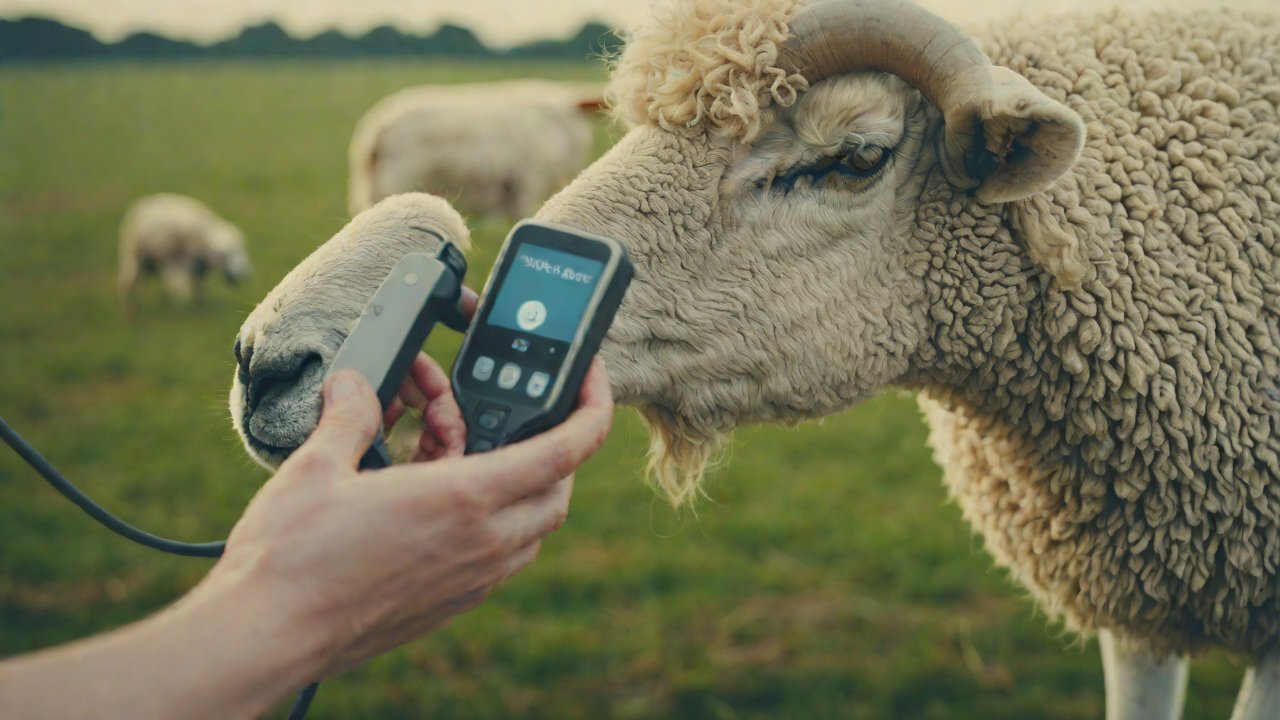
How can ear tags on fast-moving sheep be quickly read using a handheld terminal?
The use of ear tags on fast-moving sheep has become a common practice in the livestock industry, allowing for efficient tracking and identification of individual animals. However, as the speed at which sheep move can make it challenging to quickly read the ear tags, a reliable and efficient method of reading these tags is essential for effective livestock management. This report will explore the various methods and technologies used to quickly read ear tags on fast-moving sheep using a handheld terminal.
1. Current Methods and Challenges
Currently, ear tags on sheep are typically read using a handheld reader, which is placed close to the ear tag to capture the encoded information. However, the speed at which sheep move can make it difficult to quickly read the ear tags, resulting in reduced efficiency and accuracy. Some of the challenges associated with reading ear tags on fast-moving sheep include:
| Method | Challenges |
|---|---|
| Manual Reading | Requires close proximity to the ear tag, which can be difficult to achieve when sheep are moving quickly. |
| Handheld Readers | May not be able to capture the encoded information quickly enough, resulting in reduced efficiency. |
To overcome these challenges, various technologies and methods have been developed to quickly read ear tags on fast-moving sheep.
2. RFID Technology
Radio Frequency Identification (RFID) technology is widely used in the livestock industry to quickly read ear tags on fast-moving sheep. RFID tags contain a small microchip and an antenna that store the encoded information, allowing for rapid reading of the tag without the need for close proximity.
| RFID Technology | Advantages |
|---|---|
| Fast Reading | Allows for rapid reading of ear tags, even at high speeds. |
| Long Range | Can read ear tags from a distance of up to 10 feet (3 meters). |

RFID technology has several advantages, including fast reading and long range capabilities. However, it also has some limitations, including high upfront costs and the need for specialized equipment.
3. Near Field Communication (NFC)
Near Field Communication (NFC) technology is another method used to quickly read ear tags on fast-moving sheep. NFC tags contain a small microchip and an antenna that store the encoded information, allowing for rapid reading of the tag.
| NFC Technology | Advantages |
|---|---|
| Fast Reading | Allows for rapid reading of ear tags, even at high speeds. |
| Low Cost | Has lower upfront costs compared to RFID technology. |

NFC technology has several advantages, including fast reading and low costs. However, it also has some limitations, including a shorter range compared to RFID technology.
4. Other Methods and Technologies
In addition to RFID and NFC technology, other methods and technologies have been developed to quickly read ear tags on fast-moving sheep. Some of these include:
| Method | Description |
|---|---|
| Optical Scanning | Uses a camera to capture the encoded information on the ear tag. |
| Acoustic Scanning | Uses sound waves to capture the encoded information on the ear tag. |
These methods and technologies offer alternative solutions for quickly reading ear tags on fast-moving sheep.
5. Market Data and AIGC Perspectives
According to a report by Grand View Research, the global livestock identification market is expected to reach $1.4 billion by 2025, growing at a CAGR of 7.5%. The increasing demand for efficient livestock management and tracking is driving the growth of this market.
| Market Data | Description |
|---|---|
| Global Livestock Identification Market Size (2020) | $640 million |
| CAGR (2020-2025) | 7.5% |

From an AIGC (Artificial Intelligence and General Computing) perspective, the use of machine learning and artificial intelligence algorithms can enhance the efficiency and accuracy of ear tag reading. These algorithms can analyze large datasets and identify patterns, allowing for real-time tracking and monitoring of individual animals.
| AIGC Perspectives | Description |
|---|---|
| Machine Learning | Can enhance the efficiency and accuracy of ear tag reading. |
| Artificial Intelligence | Can analyze large datasets and identify patterns, allowing for real-time tracking and monitoring. |
6. Conclusion
The use of ear tags on fast-moving sheep has become a common practice in the livestock industry, allowing for efficient tracking and identification of individual animals. However, the speed at which sheep move can make it challenging to quickly read the ear tags. This report has explored various methods and technologies used to quickly read ear tags on fast-moving sheep, including RFID and NFC technology. The market data and AIGC perspectives highlight the growing demand for efficient livestock management and tracking, and the potential for machine learning and artificial intelligence to enhance the efficiency and accuracy of ear tag reading.
IOT Cloud Platform
IOT Cloud Platform is an IoT portal established by a Chinese IoT company, focusing on technical solutions in the fields of agricultural IoT, industrial IoT, medical IoT, security IoT, military IoT, meteorological IoT, consumer IoT, automotive IoT, commercial IoT, infrastructure IoT, smart warehousing and logistics, smart home, smart city, smart healthcare, smart lighting, etc.
The IoT Cloud Platform blog is a top IoT technology stack, providing technical knowledge on IoT, robotics, artificial intelligence (generative artificial intelligence AIGC), edge computing, AR/VR, cloud computing, quantum computing, blockchain, smart surveillance cameras, drones, RFID tags, gateways, GPS, 3D printing, 4D printing, autonomous driving, etc.



