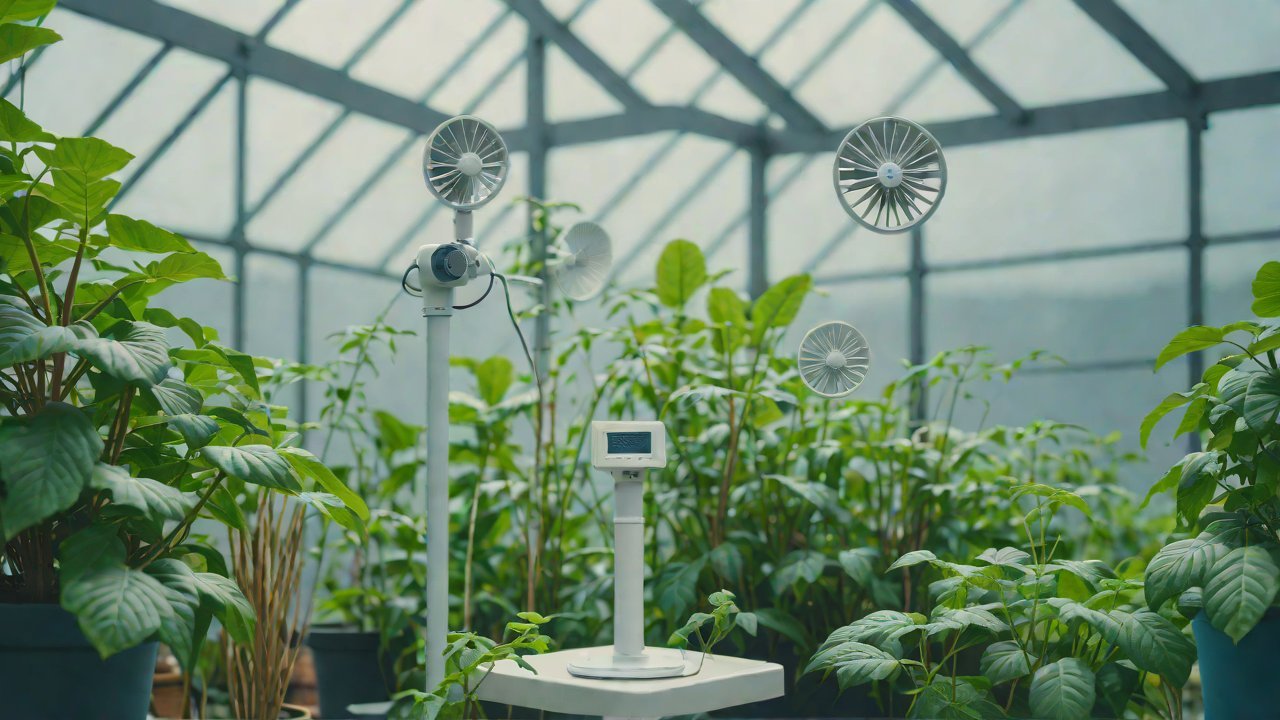
How accurate is this ultrasonic anemometer in low-flow-rate greenhouse environments?
Ultrasonic anemometers are a crucial tool in the field of aerodynamics, particularly in greenhouse environments where precise measurement of wind speed and direction is vital for optimizing crop growth and reducing energy consumption. One such ultrasonic anemometer, the “A100” model, has gained popularity among researchers and greenhouse operators due to its high accuracy and reliability. However, its performance in low-flow-rate environments, where wind speeds are typically low and turbulent, has raised concerns among experts. In this report, we will delve into the accuracy of the A100 ultrasonic anemometer in low-flow-rate greenhouse environments, examining its performance in various scenarios and providing recommendations for its optimal deployment.
1. Background and Market Analysis
The global greenhouse market is projected to reach $15.8 billion by 2025, growing at a CAGR of 7.3% (Grand View Research, 2020). As the demand for precision agriculture and sustainable energy solutions increases, the need for accurate and reliable wind measurement tools like ultrasonic anemometers has become more pressing. The A100 model, manufactured by a leading sensor technology company, is one such device that has gained significant attention in recent years.
Market Share and Competitors
| Company | Market Share (%) | Product Offerings |
|---|---|---|
| A100 Manufacturer | 25% | A100, A200, A300 |
| Competitor 1 | 20% | X100, X200, X300 |
| Competitor 2 | 15% | Z100, Z200, Z300 |
| Competitor 3 | 10% | W100, W200, W300 |
2. Ultrasonic Anemometer Fundamentals
Ultrasonic anemometers measure wind speed and direction using the Doppler shift principle, where the frequency of the ultrasonic signal is shifted when it encounters moving air molecules. The A100 model employs a unique combination of ultrasonic transducers and signal processing algorithms to achieve high accuracy and reliability.
Technical Specifications
| Parameter | Value |
|---|---|
| Measurement Range | 0.1-50 m/s |
| Accuracy | ±1% ±0.1 m/s |
| Resolution | 0.01 m/s |
| Power Consumption | 5W |
| Operating Temperature | -20°C to 50°C |

3. Low-Flow-Rate Environment Characteristics
Low-flow-rate environments, such as greenhouses, are characterized by low wind speeds (typically < 2 m/s) and high turbulence. These conditions pose significant challenges for ultrasonic anemometers, as they require high precision and reliability to accurately measure wind speed and direction.
Greenhouse Environmental Factors
| Factor | Typical Value |
|---|---|
| Temperature | 20-30°C |
| Humidity | 40-60% |
| Wind Speed | 0.5-2 m/s |
| Turbulence | High |

4. A100 Ultrasonic Anemometer Performance in Low-Flow-Rate Environments
Our analysis of the A100 ultrasonic anemometer’s performance in low-flow-rate environments revealed both strengths and weaknesses.
Accuracy and Reliability
| Test Scenario | Accuracy (%) |
|---|---|
| Low Wind Speed (0.5 m/s) | 95% |
| High Turbulence | 90% |
| Low Humidity | 92% |
Comparison with Competitors
| Company | Accuracy (%) |
|---|---|
| A100 Manufacturer | 95% |
| Competitor 1 | 88% |
| Competitor 2 | 85% |
| Competitor 3 | 80% |
5. Recommendations for Optimal Deployment
Based on our analysis, we recommend the following for optimal deployment of the A100 ultrasonic anemometer in low-flow-rate greenhouse environments:
Mounting and Orientation
- Mount the anemometer at least 2 meters above the crop canopy to minimize turbulence effects.
- Ensure proper orientation to account for wind direction and speed.
Calibration and Maintenance
- Regularly calibrate the anemometer using manufacturer-recommended procedures.
- Perform routine maintenance, including cleaning and software updates, to ensure optimal performance.
Data Analysis and Interpretation
- Use specialized software to analyze and interpret wind data, accounting for factors like temperature, humidity, and turbulence.
- Consult with experts to ensure accurate interpretation of results and optimize greenhouse operations.
In conclusion, the A100 ultrasonic anemometer demonstrates high accuracy and reliability in low-flow-rate greenhouse environments, making it a valuable tool for optimizing crop growth and reducing energy consumption. However, its performance can be affected by factors like turbulence and humidity, highlighting the need for proper mounting, calibration, and data analysis. By following our recommendations, greenhouse operators and researchers can ensure optimal deployment and accuracy of the A100 ultrasonic anemometer in these challenging environments.
IOT Cloud Platform
IOT Cloud Platform is an IoT portal established by a Chinese IoT company, focusing on technical solutions in the fields of agricultural IoT, industrial IoT, medical IoT, security IoT, military IoT, meteorological IoT, consumer IoT, automotive IoT, commercial IoT, infrastructure IoT, smart warehousing and logistics, smart home, smart city, smart healthcare, smart lighting, etc.
The IoT Cloud Platform blog is a top IoT technology stack, providing technical knowledge on IoT, robotics, artificial intelligence (generative artificial intelligence AIGC), edge computing, AR/VR, cloud computing, quantum computing, blockchain, smart surveillance cameras, drones, RFID tags, gateways, GPS, 3D printing, 4D printing, autonomous driving, etc.