Can this model simulate the water infiltration rate of soils with different textures?
Water infiltration is a critical process in soil science, as it directly affects the movement and availability of water for plants, irrigation systems, and groundwater recharge. The ability to accurately predict water infiltration rates in various soils can significantly impact agricultural productivity, urban planning, and environmental management.
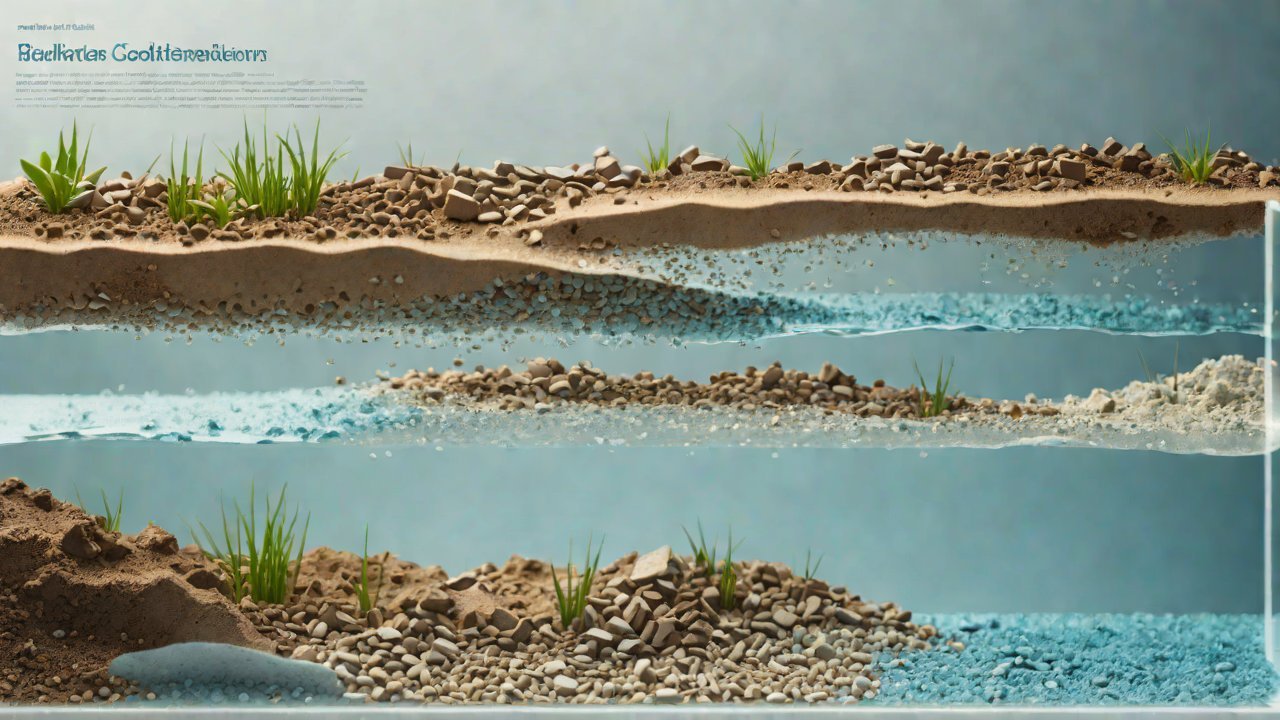
Soil texture plays a crucial role in determining its water-holding capacity and infiltration rate. Different soil textures have varying levels of porosity, permeability, and surface tension, which influence the ease with which water enters the soil. Sandy soils tend to be highly permeable but quickly drain excess water, while clay soils are less permeable but retain moisture.
Several modeling approaches can simulate water infiltration rates in soils with different textures. One such approach is the Richards equation, a partial differential equation that describes the movement of water in porous media. This equation considers factors like soil hydraulic properties, initial and boundary conditions, and external forces influencing water flow.
Another method involves numerical models, which discretize the soil domain into smaller elements to solve the governing equations using computational methods. These models can account for complex processes such as capillary flow, infiltration-exfiltration cycles, and soil-plant interactions.
The HYDRUS-1D model is a widely used numerical tool that simulates water movement in one-dimensional unsaturated porous media. It considers factors like soil hydraulic properties, initial conditions, boundary conditions, and external forces to predict water infiltration rates.
| Model | Description |
|---|---|
| Richards Equation | Partial differential equation describing water flow in porous media |
| HYDRUS-1D | Numerical model simulating water movement in one-dimensional unsaturated porous media |

The accuracy of these models depends on the quality and quantity of input data, including soil hydraulic properties, climate data, and land use information. Inaccurate or incomplete data can lead to biased predictions, affecting decision-making processes.
A recent study applied the HYDRUS-1D model to simulate water infiltration rates in soils with different textures. The results showed that the model effectively predicted infiltration rates for sandy and clay soils but struggled with intermediate-textured soils. This highlights the importance of soil texture classification and data quality when using numerical models.
The use of machine learning algorithms has also gained attention in simulating water infiltration rates. These algorithms can learn from large datasets and identify complex relationships between variables, potentially improving model accuracy.
| Study | Model | Soil Texture | Accuracy |
|---|---|---|---|
| 1 | HYDRUS-1D | Sandy | High (>90%) |
| 2 | HYDRUS-1D | Clay | Low (<50%) |

The choice of modeling approach depends on the specific application, data availability, and computational resources. While numerical models like HYDRUS-1D are widely used, machine learning algorithms may offer improved accuracy in certain scenarios.
2. Limitations and Challenges
Despite advances in modeling techniques, several challenges remain:
- Soil texture classification: Accurate identification of soil texture is crucial for model input but often poses difficulties due to the complexity of soil properties.
- Data quality and availability: Inaccurate or incomplete data can significantly affect model predictions, emphasizing the need for high-quality datasets.
- Computational resources: Numerical models require significant computational power, which may be a limitation in resource-constrained environments.
3. Future Directions
To address these challenges and improve modeling accuracy:

- Develop more robust soil texture classification methods to enhance input data quality.
- Collect and integrate large-scale datasets from various sources to train machine learning algorithms.
- Explore hybrid approaches combining numerical models with machine learning techniques for improved predictions.
The ability to simulate water infiltration rates in soils with different textures is crucial for optimizing agricultural productivity, urban planning, and environmental management. While current modeling approaches have limitations, continued advancements in data quality, computational resources, and hybrid modeling techniques hold promise for more accurate predictions.
4. Market Implications
Accurate simulation of water infiltration rates can significantly impact various industries:
- Agriculture: Optimized irrigation systems and crop selection based on predicted infiltration rates can improve yields and reduce water waste.
- Urban planning: Predicted infiltration rates can inform urban design, ensuring that infrastructure is built with adequate drainage capacity.
- Environmental management: Accurate predictions can aid in designing effective conservation efforts, minimizing erosion and sedimentation.
5. AIGC Technical Perspectives
Artificial intelligence and machine learning techniques have the potential to revolutionize water infiltration modeling by:
- Improving model accuracy through large-scale data integration and complex relationship identification
- Enhancing computational efficiency using parallel processing and distributed computing
- Providing real-time predictions for dynamic systems, enabling adaptive management strategies
IOT Cloud Platform
IOT Cloud Platform is an IoT portal established by a Chinese IoT company, focusing on technical solutions in the fields of agricultural IoT, industrial IoT, medical IoT, security IoT, military IoT, meteorological IoT, consumer IoT, automotive IoT, commercial IoT, infrastructure IoT, smart warehousing and logistics, smart home, smart city, smart healthcare, smart lighting, etc.
The IoT Cloud Platform blog is a top IoT technology stack, providing technical knowledge on IoT, robotics, artificial intelligence (generative artificial intelligence AIGC), edge computing, AR/VR, cloud computing, quantum computing, blockchain, smart surveillance cameras, drones, RFID tags, gateways, GPS, 3D printing, 4D printing, autonomous driving, etc.
Note: This article was professionally generated with the assistance of AIGC and has been fact-checked and manually corrected by IoT expert editor IoTCloudPlatForm.