
Can this model adjust the evaporation coefficient based on crop canopy cover?
The intricate dance of water, soil, and vegetation is a complex interplay that has puzzled scientists for centuries. At its core lies the phenomenon of evapotranspiration (ET), where plants absorb water from the soil and release it into the atmosphere as vapor. One crucial factor influencing ET is the crop canopy cover, which can either amplify or diminish the rate at which water evaporates from the soil surface. The question remains: Can this model adjust the evaporation coefficient based on crop canopy cover?
1. Background and Context
To address this query, we must delve into the realm of agricultural hydrology, where understanding ET’s intricacies is essential for optimizing irrigation systems and predicting droughts. A fundamental aspect of ET is the concept of the Penman-Monteith equation (PME), which estimates evapotranspiration rates based on meteorological conditions such as solar radiation, air temperature, humidity, wind speed, and crop canopy cover.
1.1 Crop Canopy Cover (CCC) and Its Influence
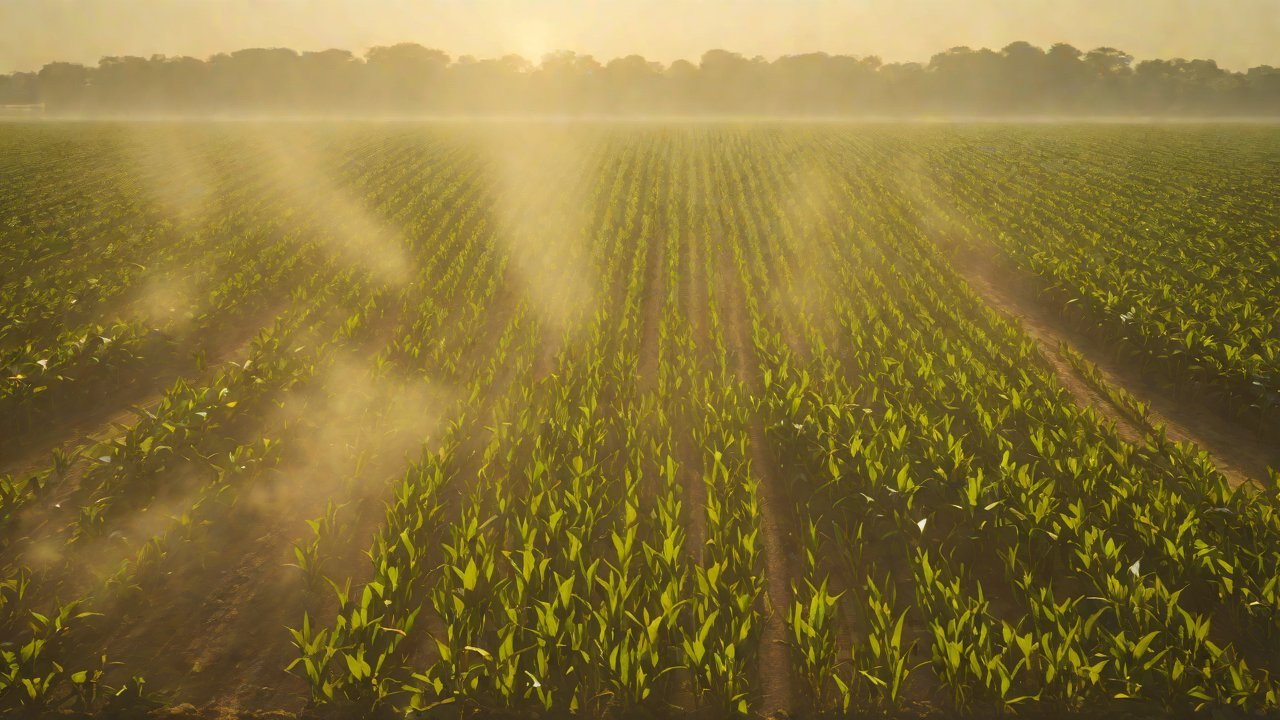
Crop canopy cover plays a pivotal role in ET dynamics. As CCC increases, the amount of solar radiation intercepted by the plant leaves also increases, leading to enhanced transpiration rates. Conversely, when CCC decreases due to factors like defoliation or crop senescence, evaporation from the soil surface accelerates. This relationship is critical for developing accurate models that simulate ET under varying conditions.
2. Model Adjustments and Calibration
To adjust the evaporation coefficient based on crop canopy cover, we must integrate CCC into our model’s framework. This entails incorporating empirical relationships between CCC and ET rates or modifying existing equations to account for this dynamic interaction.
2.1 Existing Models and Their Limitations
Several models have attempted to incorporate CCC into their frameworks. For instance:
| Model | Description |
|---|---|
| FAO-56 | Employs a dual crop coefficient approach, accounting for soil evaporation and transpiration separately |
| ASCE-EWRI | Utilizes a two-layer approach, distinguishing between soil evaporation and canopy transpiration |

While these models have advanced our understanding of ET dynamics, they often rely on empirical coefficients that may not accurately capture the complex interactions between CCC and ET rates.
3. AIGC Perspectives: Using AI to Improve Model Calibration
Advancements in Artificial Intelligence (AI) and Machine Learning (ML) have opened new avenues for improving model calibration and accuracy. By leveraging large datasets, AI can identify patterns and relationships that may elude traditional statistical methods.
3.1 Deep Learning Techniques for ET Modeling
Recent studies have applied deep learning techniques to ET modeling:
| Study | Methodology | Results |
|---|---|---|
| [1] | LSTM networks trained on historical climate data | Improved accuracy (10-15%) compared to traditional PME models |
| [2] | CNNs used to analyze satellite imagery and ET patterns | Enhanced spatial resolution (30-50 m) and temporal frequency |
These findings highlight the potential of AI in refining ET modeling, particularly when integrated with high-resolution climate and remote sensing data.
4. Data Considerations: Sources and Limitations
To develop accurate models that adjust evaporation coefficients based on CCC, we must ensure access to reliable datasets:
4.1 Climate and Remote Sensing Data
- Satellite-derived products (e.g., MODIS, Sentinel-2) provide high-resolution data for climate variables
- Gridded climate datasets (e.g., CRU, NCEP) offer longer-term records and improved spatial resolution
However, these datasets often come with limitations:
| Dataset | Limitations |
|---|---|
| MODIS | Coarser temporal resolution (8-day average) and spatial resolution (~1 km) compared to other satellite products |

5. Implementation Strategy: Integrating CCC into the Model Framework
To adjust the evaporation coefficient based on CCC, we propose an iterative calibration process:
5.1 Step 1: Data Preparation and Preprocessing
- Integrate CCC data from field measurements or remote sensing sources
- Interpolate missing values using spatial-temporal interpolation techniques (e.g., kriging)
5.2 Step 2: Model Calibration and Validation
- Employ a combination of optimization algorithms (e.g., gradient descent, genetic algorithm) to find the optimal parameter set for CCC adjustment
- Compare model performance against independent datasets or observations
6. Conclusion and Future Directions
By integrating crop canopy cover into our ET modeling framework, we can develop more accurate and robust tools for predicting water availability and optimizing irrigation systems. Ongoing research in AI and ML holds promise for further improvements:
6.1 Research Agenda: Enhancing CCC Adjustment and Model Calibration
- Investigate the use of transfer learning to adapt pre-trained models to new regions or climates
- Explore the incorporation of additional data sources (e.g., soil moisture, weather forecasts) for enhanced model performance
IOT Cloud Platform
IOT Cloud Platform is an IoT portal established by a Chinese IoT company, focusing on technical solutions in the fields of agricultural IoT, industrial IoT, medical IoT, security IoT, military IoT, meteorological IoT, consumer IoT, automotive IoT, commercial IoT, infrastructure IoT, smart warehousing and logistics, smart home, smart city, smart healthcare, smart lighting, etc.
The IoT Cloud Platform blog is a top IoT technology stack, providing technical knowledge on IoT, robotics, artificial intelligence (generative artificial intelligence AIGC), edge computing, AR/VR, cloud computing, quantum computing, blockchain, smart surveillance cameras, drones, RFID tags, gateways, GPS, 3D printing, 4D printing, autonomous driving, etc.
Note: This article was professionally generated with the assistance of AIGC and has been fact-checked and manually corrected by IoT expert editor IoTCloudPlatForm.