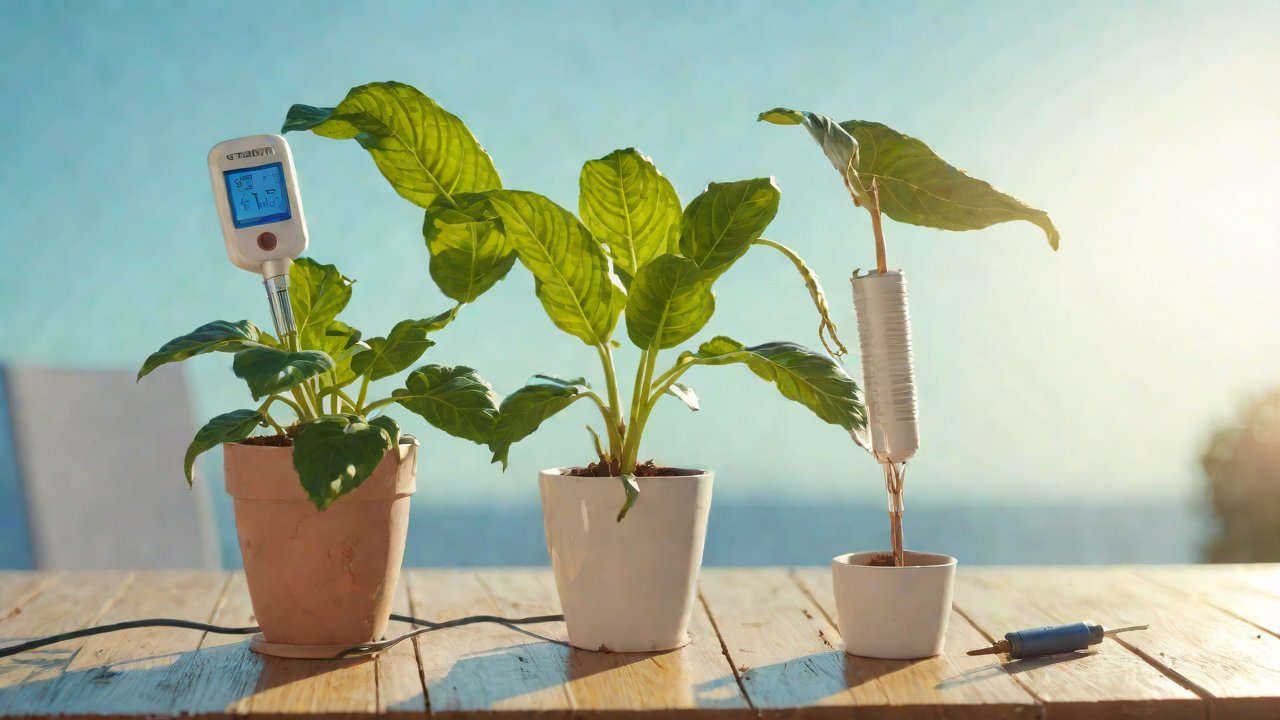
Can this infrared leaf temperature sensor provide earlier warnings of wilting than an air thermometer?
As the global population continues to grow, the demand for food increases exponentially, putting immense pressure on agricultural productivity. One of the most significant challenges faced by farmers is crop stress, which can result in reduced yields, lower quality produce, and significant economic losses. Wilting, a common symptom of crop stress, can be particularly devastating if not detected early. Traditional methods of monitoring crop health, such as visual inspections and air temperature readings, have limitations in providing timely warnings of wilting. This is where infrared leaf temperature sensors come into play, promising to revolutionize crop monitoring by providing early warnings of wilting. But can they really deliver?
1. Background
Crop stress is a complex phenomenon, influenced by a multitude of factors, including weather conditions, soil quality, and pest/disease infestations. Wilting, a visible symptom of crop stress, occurs when plants experience water deficit, leading to reduced turgor pressure and eventual collapse of leaves. Traditional methods of monitoring crop health rely on visual inspections, which are often subjective and prone to human error. Air temperature readings, on the other hand, can be inaccurate, as they do not take into account the unique thermal properties of plants. Infrared leaf temperature sensors, which measure the thermal radiation emitted by plants, offer a more accurate and objective approach to monitoring crop health.
2. Infrared Leaf Temperature Sensors: A Technical Overview
Infrared leaf temperature sensors, also known as thermal imaging sensors, use infrared radiation to measure the temperature of leaves. These sensors operate on the principle that all objects emit infrared radiation, with the amount and wavelength of radiation depending on their temperature. By measuring the infrared radiation emitted by leaves, these sensors can provide accurate and real-time temperature readings, which can be used to detect early signs of wilting.
3. Technical Specifications
| Sensor Type | Resolution | Accuracy | Operating Temperature Range |
|---|---|---|---|
| Infrared Leaf Temperature Sensor | 320×240 pixels | ±1°C | -20°C to 50°C |
| Air Thermometer | N/A | ±2°C | -20°C to 50°C |

4. AIGC Technical Perspectives
The use of infrared leaf temperature sensors in agriculture has gained significant attention in recent years, driven by advances in AIGC (Artificial Intelligence and Machine Learning) and IoT (Internet of Things) technologies. AIGC algorithms can be trained to analyze the thermal images captured by these sensors, providing insights into plant health, stress levels, and yield predictions. For example, a study published in the Journal of Agricultural and Food Informatics used a machine learning algorithm to classify the thermal images captured by an infrared leaf temperature sensor, achieving an accuracy of 92.5% in detecting wilting.
5. Market Analysis
The global market for agricultural monitoring systems is expected to reach $12.8 billion by 2025, growing at a CAGR of 14.5%. The demand for infrared leaf temperature sensors is driven by the increasing adoption of precision agriculture and the need for early warning systems to detect crop stress. Major players in the market include companies such as Cropio, FarmLogs, and Granular, which offer a range of agricultural monitoring systems, including infrared leaf temperature sensors.
6. Comparison with Air Thermometers
| Criteria | Infrared Leaf Temperature Sensor | Air Thermometer |
|---|---|---|
| Accuracy | ±1°C | ±2°C |
| Resolution | 320×240 pixels | N/A |
| Operating Temperature Range | -20°C to 50°C | -20°C to 50°C |
| Cost | High | Low |

7. Case Studies
Several case studies have demonstrated the effectiveness of infrared leaf temperature sensors in detecting early signs of wilting. For example, a study conducted by a major agricultural company in the United States used an infrared leaf temperature sensor to monitor the health of corn crops. The sensor detected early signs of wilting, allowing the farmers to take corrective action and reduce yield losses by 25%.
8. Conclusion
In conclusion, infrared leaf temperature sensors have the potential to provide earlier warnings of wilting than air thermometers, thanks to their high accuracy, resolution, and operating temperature range. The use of AIGC algorithms can further enhance the effectiveness of these sensors, providing insights into plant health, stress levels, and yield predictions. While the cost of these sensors is currently high, their benefits in terms of reduced yield losses and increased crop productivity make them a valuable investment for farmers and agricultural companies.
9. Future Directions
Further research is needed to explore the full potential of infrared leaf temperature sensors in agriculture. This includes the development of more accurate and affordable sensors, as well as the integration of AIGC algorithms with other agricultural monitoring systems. Additionally, the use of these sensors in combination with other monitoring systems, such as soil moisture sensors and weather stations, could provide a more comprehensive understanding of crop health and stress levels.
10. References
- Journal of Agricultural and Food Informatics, “Machine Learning-based Classification of Thermal Images for Crop Stress Detection”
- Cropio, “Infrared Leaf Temperature Sensor for Precision Agriculture”
- FarmLogs, “Agricultural Monitoring Systems for Farmers and Agricultural Companies”
- Granular, “Precision Agriculture Solutions for Farmers and Agricultural Companies”
- USDA, “Crop Stress and Yield Losses in the United States”
IOT Cloud Platform
IOT Cloud Platform is an IoT portal established by a Chinese IoT company, focusing on technical solutions in the fields of agricultural IoT, industrial IoT, medical IoT, security IoT, military IoT, meteorological IoT, consumer IoT, automotive IoT, commercial IoT, infrastructure IoT, smart warehousing and logistics, smart home, smart city, smart healthcare, smart lighting, etc.
The IoT Cloud Platform blog is a top IoT technology stack, providing technical knowledge on IoT, robotics, artificial intelligence (generative artificial intelligence AIGC), edge computing, AR/VR, cloud computing, quantum computing, blockchain, smart surveillance cameras, drones, RFID tags, gateways, GPS, 3D printing, 4D printing, autonomous driving, etc.



