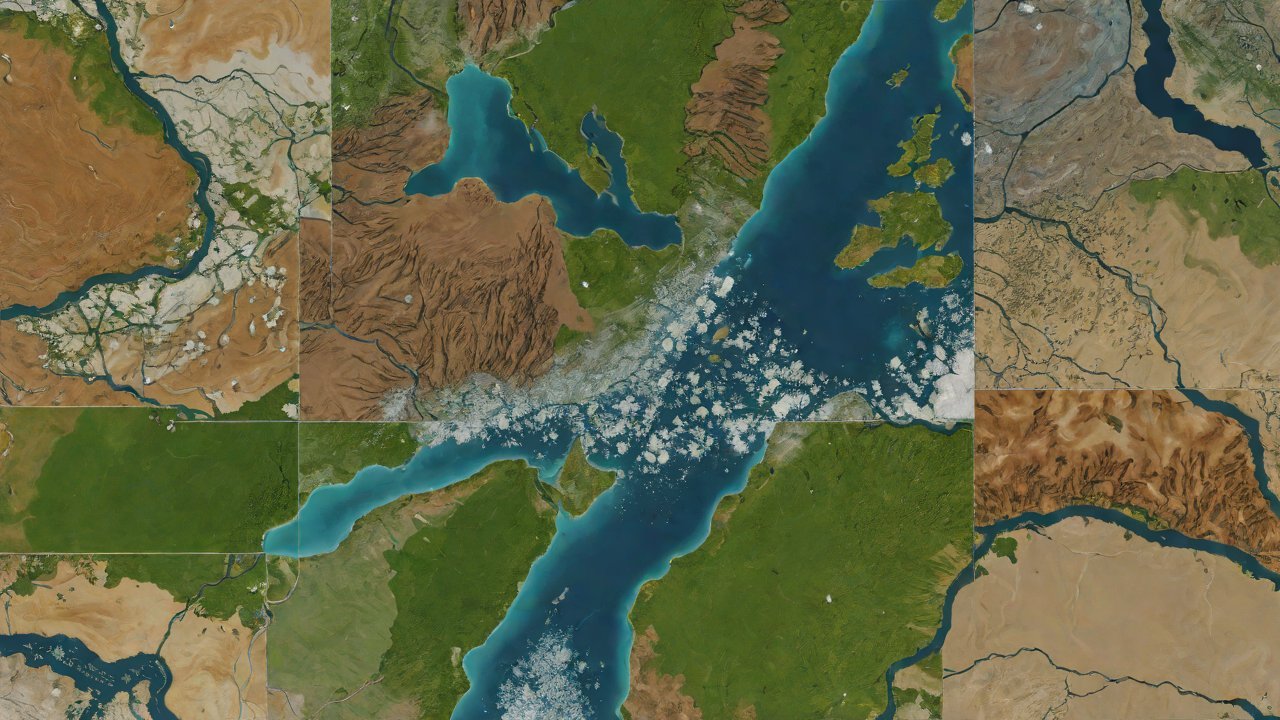
Can algorithms, combined with MODIS data, expand the coverage of soil moisture monitoring?
The accuracy of agricultural decision-making is heavily reliant on timely and accurate soil moisture data. However, current methods for collecting such data often have significant limitations in terms of spatial resolution, temporal frequency, and cost-effectiveness. The integration of satellite-based Moderate Resolution Imaging Spectroradiometer (MODIS) data with advanced algorithms could potentially alleviate these issues by providing an unprecedented level of detail and coverage.
MODIS is a key component of the NASA Earth Observing System (EOS), capturing high-resolution images of the Earth’s surface across various spectral bands. Its widespread availability, coupled with its relatively low cost compared to other remote sensing technologies, makes it an attractive choice for large-scale monitoring applications. The spatial resolution of MODIS data can be aggregated to match that of existing soil moisture measurement tools, effectively bridging the gap between high-resolution satellite imagery and coarse-grained in situ measurements.
1. Current State of Soil Moisture Monitoring
Soil moisture is a critical factor in agricultural productivity, with its variations significantly impacting crop yields and water usage efficiency. Traditionally, soil moisture has been measured using in situ sensors, which are often spatially limited to specific locations within a field or region. This approach can be time-consuming and expensive when applied at large scales.
Remote sensing techniques have gained popularity as an alternative method for monitoring soil moisture due to their ability to cover vast areas with minimal human intervention. However, the accuracy of these methods is heavily dependent on atmospheric conditions, vegetation density, and sensor resolution. MODIS data offers a balance between spatial coverage and spectral detail, making it an attractive choice for large-scale soil moisture monitoring.
2. Algorithmic Enhancements
The integration of algorithms with MODIS data can enhance the accuracy and efficiency of soil moisture monitoring in several ways:
- Data Fusion: Combining MODIS data with other sources of information (e.g., weather forecasts, soil type) to create a more comprehensive picture of soil moisture conditions.
- Machine Learning: Applying machine learning techniques to identify patterns within MODIS data that correlate with soil moisture levels, thereby improving prediction accuracy.
- Spectral Indexing: Utilizing specific spectral indices derived from MODIS data to estimate soil moisture, which can be more sensitive than traditional methods.
3. Technical Perspective

From a technical standpoint, the integration of algorithms and MODIS data is feasible due to advancements in computing power and data storage capabilities. This enables the processing of large datasets in real-time or near-real-time, making it possible for farmers and policymakers to make informed decisions based on up-to-date soil moisture information.
Algorithmic Approaches
Several algorithmic approaches can be employed to enhance soil moisture monitoring using MODIS data:
| Approach | Description |
|---|---|
| Neural Networks | Utilize neural networks to identify complex patterns in MODIS data that correlate with soil moisture levels. |
| Support Vector Machines | Employ support vector machines to classify different soil moisture conditions based on MODIS-derived spectral indices. |
| Random Forests | Use random forests to combine multiple predictors derived from MODIS data, increasing the accuracy of soil moisture estimates. |

4. Market Trends and Future Outlook

The market for remote sensing technologies in agriculture is rapidly expanding due to growing concerns over water scarcity and crop productivity. The integration of algorithms with MODIS data is expected to play a significant role in this expansion.
- Increasing Adoption: More farmers and agricultural organizations are adopting remote sensing technologies for soil moisture monitoring, driven by the need for precision farming practices.
- Advancements in Technology: Continuous improvements in computing power, data storage, and algorithmic sophistication will further enhance the accuracy and efficiency of MODIS-based soil moisture monitoring.
5. Challenges and Limitations
Despite its potential benefits, the integration of algorithms with MODIS data also faces several challenges:
- Data Quality: The quality of MODIS data can be affected by atmospheric conditions, sensor calibration issues, and other factors.
- Algorithmic Complexity: Developing accurate algorithms that can handle large datasets and account for various environmental factors is a complex task.
6. Conclusion
The integration of algorithms with MODIS data has the potential to significantly expand the coverage of soil moisture monitoring. By leveraging the strengths of both remote sensing technologies and advanced algorithmic techniques, it becomes possible to provide accurate and timely information on soil moisture conditions at large scales. As technology continues to evolve, we can expect even more sophisticated solutions for soil moisture monitoring that will support more efficient use of water resources in agriculture.
IOT Cloud Platform
IOT Cloud Platform is an IoT portal established by a Chinese IoT company, focusing on technical solutions in the fields of agricultural IoT, industrial IoT, medical IoT, security IoT, military IoT, meteorological IoT, consumer IoT, automotive IoT, commercial IoT, infrastructure IoT, smart warehousing and logistics, smart home, smart city, smart healthcare, smart lighting, etc.
The IoT Cloud Platform blog is a top IoT technology stack, providing technical knowledge on IoT, robotics, artificial intelligence (generative artificial intelligence AIGC), edge computing, AR/VR, cloud computing, quantum computing, blockchain, smart surveillance cameras, drones, RFID tags, gateways, GPS, 3D printing, 4D printing, autonomous driving, etc.
Note: This article was professionally generated with the assistance of AIGC and has been fact-checked and manually corrected by IoT expert editor IoTCloudPlatForm.