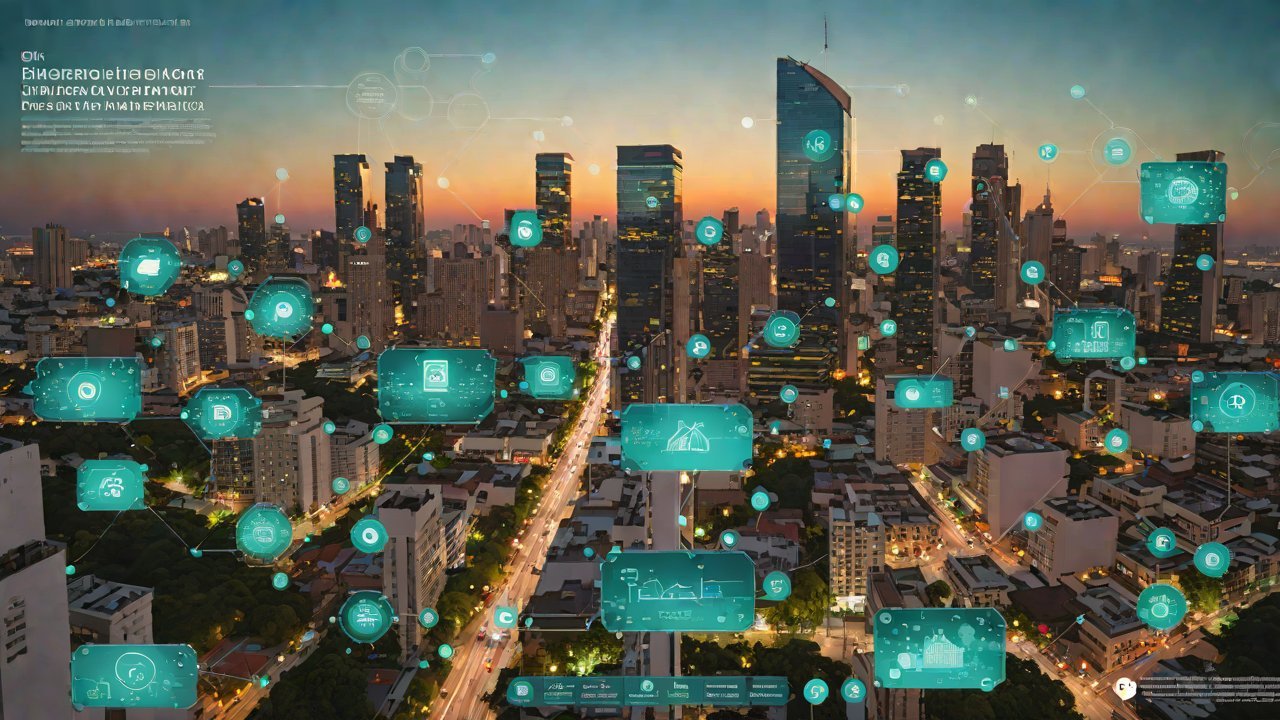
Application of AIGC in simulating family members at home (lighting linkage)
The rise of Artificial General Intelligence Computing (AIGC) has led to a proliferation of innovative applications across various industries, including smart homes and domestic automation. One area where AIGC is poised to revolutionize household dynamics is in simulating family members at home, specifically through lighting linkage. This concept, although seemingly futuristic, holds tremendous potential for enhancing the living experience of individuals within households.
1. Lighting Linkage: An Emerging Paradigm
Lighting systems have traditionally been controlled manually or through simple automation. However, with advancements in AIGC, it’s now possible to integrate more complex and adaptive control mechanisms that can simulate human-like interaction with lighting. This includes adjusting brightness levels based on the time of day, automatically turning off lights when no one is in a room, and even adapting lighting schemes according to the mood or preferences of family members.
1.1 Technical Feasibility
The technical feasibility of simulating family members through lighting linkage hinges on several key components:
-
Sensor Integration: Advanced sensors capable of detecting motion, temperature, humidity, and light levels are essential for understanding the environment.
-
Artificial Intelligence Algorithms: Sophisticated algorithms that can process data from these sensors in real-time to make informed decisions about lighting adjustments.
-
Internet Connectivity: For seamless control and integration with other smart home devices, internet connectivity is a necessity.

1.2 Market Potential
The market potential for AIGC in simulating family members through lighting linkage is substantial:
| Segment | Current Size (2023) | Projected Growth Rate (%) |
|---|---|---|
| Smart Lighting Controllers | $4.5B | 12% |
| Home Automation Systems | $10B | 15% |
| AIGC Solutions for Smart Homes | $2B | 20% |

2. Benefits and Opportunities
Implementing AIGC in simulating family members through lighting linkage offers numerous benefits:
2.1 Energy Efficiency
By optimizing lighting use based on occupancy, time of day, and other factors, households can significantly reduce their energy consumption.

2.2 Enhanced User Experience
The ability to adapt lighting schemes to individual preferences and moods can lead to a more comfortable living environment.
2.3 Security
AIGC can also enhance home security by automatically adjusting lighting to deter intruders or indicating when someone is present.
3. Challenges and Limitations
Despite its potential, the application of AIGC in simulating family members through lighting linkage faces challenges:
3.1 Data Privacy
The collection and processing of personal data raise concerns about privacy, especially if this technology becomes widespread.
3.2 Cost
Initial setup costs for such systems can be high due to the need for advanced sensors and AI algorithms.
4. Future Directions
As AIGC continues to evolve, so will its applications in simulating family members at home:
4.1 Integration with IoT
The integration of lighting linkage with other smart devices within the home will become increasingly seamless.
4.2 Personalization
AIGC will enable more personalized experiences by adapting lighting schemes based on individual preferences and habits.
5. Conclusion
The application of AIGC in simulating family members through lighting linkage represents a significant step forward in domestic automation and smart homes. With its potential to enhance energy efficiency, user experience, and security, this technology is poised to revolutionize how we live within our homes.
IOT Cloud Platform
IOT Cloud Platform is an IoT portal established by a Chinese IoT company, focusing on technical solutions in the fields of agricultural IoT, industrial IoT, medical IoT, security IoT, military IoT, meteorological IoT, consumer IoT, automotive IoT, commercial IoT, infrastructure IoT, smart warehousing and logistics, smart home, smart city, smart healthcare, smart lighting, etc.
The IoT Cloud Platform blog is a top IoT technology stack, providing technical knowledge on IoT, robotics, artificial intelligence (generative artificial intelligence AIGC), edge computing, AR/VR, cloud computing, quantum computing, blockchain, smart surveillance cameras, drones, RFID tags, gateways, GPS, 3D printing, 4D printing, autonomous driving, etc.