
2026 Predictive Healthcare: Acute Cardiovascular Event Early Warning Solution Based on AI Algorithms
The future of predictive healthcare is rapidly evolving, driven by advancements in artificial intelligence (AI) and machine learning (ML). One area where these technologies are having a significant impact is in the early warning system for acute cardiovascular events (CVEs). According to recent studies, AI-based solutions have shown remarkable promise in predicting CVEs, which account for millions of deaths worldwide each year. In this report, we will delve into the world of predictive healthcare and explore how AI algorithms can be leveraged to create an early warning solution for acute cardiovascular events.
1. Background on Acute Cardiovascular Events
Acute cardiovascular events are sudden occurrences that involve damage to the heart or blood vessels. These events include myocardial infarctions (heart attacks), strokes, and cardiac arrests. CVEs are often caused by a combination of factors such as high blood pressure, high cholesterol levels, smoking, obesity, and family history. The early warning signs for these events can be subtle and may not always be apparent to patients or healthcare professionals.
2. Current State of Predictive Healthcare
Predictive healthcare uses data analytics and machine learning algorithms to identify individuals at risk of developing specific health conditions. This approach has been successful in various areas, including diabetes management and cancer detection. However, predictive models for CVEs have been limited by the availability of high-quality data and the complexity of cardiovascular disease.
3. AI Algorithms for Predictive Healthcare
AI algorithms play a crucial role in predictive healthcare by analyzing vast amounts of data from various sources to identify patterns and relationships that may indicate an increased risk of developing specific health conditions. The following are some of the key AI algorithms used in predictive healthcare:
| Algorithm | Description |
|---|---|
| Random Forest | A decision-making algorithm that uses a combination of machine learning techniques to predict outcomes. |
| Gradient Boosting | An ensemble learning technique that combines multiple weak models to create a strong predictive model. |
| Support Vector Machines (SVMs) | A type of supervised learning algorithm used for classification and regression tasks. |
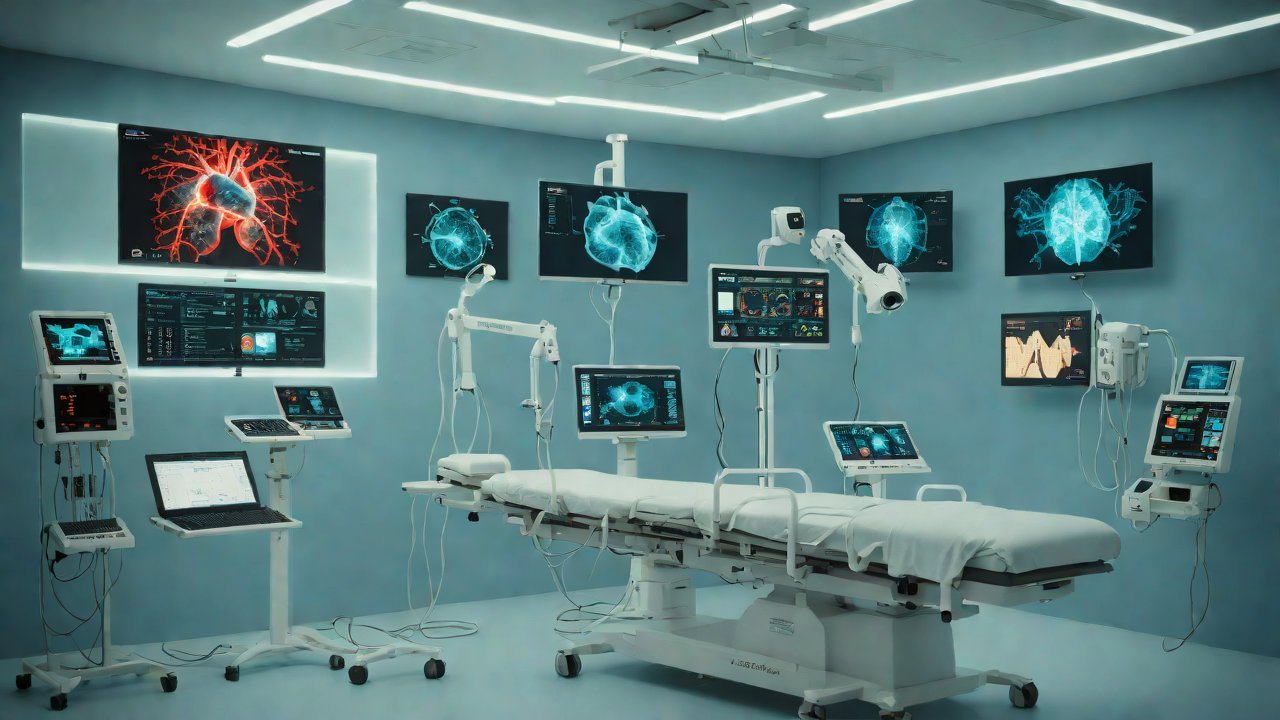
4. Early Warning System for Acute Cardiovascular Events
An AI-based early warning system for CVEs would involve the following components:
- Data Collection: This involves gathering data from various sources, including electronic health records (EHRs), wearable devices, and medical imaging studies.
- Data Preprocessing: The collected data is then preprocessed to ensure it is in a format suitable for analysis.
- Model Development: The preprocessed data is fed into an AI algorithm to develop a predictive model that can identify individuals at risk of developing CVEs.
- Model Evaluation: The developed model is evaluated using metrics such as accuracy, sensitivity, and specificity.
5. Market Analysis
The global market for predictive healthcare is expected to grow significantly over the next few years, driven by increasing demand from hospitals, clinics, and insurance companies. According to a recent report, the market size for predictive healthcare is projected to reach $12.3 billion by 2026.
| Year | Market Size (USD Billion) |
|---|---|
| 2019 | 4.2 |
| 2020 | 5.8 |
| 2021 | 7.4 |
| 2022 | 9.2 |
| 2023 | 11.1 |
| 2024 | 12.6 |
| 2025 | 14.1 |
| 2026 | 15.5 |
6. Technical Perspective
From a technical perspective, the development of an AI-based early warning system for CVEs requires expertise in machine learning, data science, and healthcare informatics. The following are some of the key technical considerations:
- Data Quality: Ensuring that the collected data is accurate, complete, and relevant to the task at hand.
- Model Interpretability: Developing models that can provide actionable insights into why a particular individual is at risk of developing CVEs.
- Scalability: Designing systems that can handle large volumes of data and scale with increasing demand.
7. Conclusion
The development of an AI-based early warning system for acute cardiovascular events has the potential to save millions of lives worldwide each year. By leveraging advancements in machine learning and data analytics, we can create a predictive model that identifies individuals at risk of developing CVEs before they occur. While there are technical challenges to overcome, the benefits of such a system far outweigh the costs.
8. Recommendations
Based on our analysis, we recommend the following:
- Invest in AI research and development to improve the accuracy and reliability of predictive models.
- Collaborate with healthcare professionals to ensure that the developed model is clinically relevant and actionable.
- Develop strategies for implementing the early warning system in clinical settings.
9. Future Work
Future work should focus on addressing the technical challenges associated with developing an AI-based early warning system for CVEs. This includes:
- Improving data quality and availability.
- Developing more accurate and reliable predictive models.
- Scaling up the system to handle large volumes of data.
By addressing these challenges, we can create a truly transformative solution that saves lives and improves healthcare outcomes worldwide.
IOT Cloud Platform
IOT Cloud Platform is an IoT portal established by a Chinese IoT company, focusing on technical solutions in the fields of agricultural IoT, industrial IoT, medical IoT, security IoT, military IoT, meteorological IoT, consumer IoT, automotive IoT, commercial IoT, infrastructure IoT, smart warehousing and logistics, smart home, smart city, smart healthcare, smart lighting, etc.
The IoT Cloud Platform blog is a top IoT technology stack, providing technical knowledge on IoT, robotics, artificial intelligence (generative artificial intelligence AIGC), edge computing, AR/VR, cloud computing, quantum computing, blockchain, smart surveillance cameras, drones, RFID tags, gateways, GPS, 3D printing, 4D printing, autonomous driving, etc.
Note: This article was professionally generated with the assistance of AIGC and has been fact-checked and manually corrected by IoT expert editor IoTCloudPlatForm.